Ch.14 - Chemical Kinetics
Brown - Chemistry: The Central Science 15th Edition
Brown15th EditionChemistry: The Central ScienceISBN: 9780137542970Non è quello che usi tu?Cambia libro di testo
Capitolo 14, Problema 54

(a) The activation energy for the isomerization of methyl isonitrile (Figure 14.6) is 160 kJ>mol. Calculate the fraction of methyl isonitrile molecules that has an energy equal to or greater than the activation energy at 500 K. (b) Calculate this fraction for a temperature of 520 K. What is the ratio of the fraction at 520 K to that at 500 K?

Guida verificata passo dopo passo
1
Identify the given values: Activation energy (Ea) = 160 kJ/mol, Temperature (T) = 500 K for part (a) and 520 K for part (b).
Convert the activation energy from kJ/mol to J/mol by multiplying by 1000, since 1 kJ = 1000 J.
Use the Arrhenius equation in the form that relates the fraction of molecules (f) with energy equal to or greater than the activation energy: f = e^{-Ea/(RT)}, where R is the gas constant (8.314 J/mol\(\cdot\) K).
Calculate the fraction (f) for each temperature by substituting the values of Ea, R, and T into the equation. Perform this calculation separately for T = 500 K and T = 520 K.
To find the ratio of the fractions at 520 K to 500 K, divide the fraction calculated at 520 K by the fraction calculated at 500 K.

Risposta video verificata per un problema simile:

Questa soluzione video è stata consigliata dai nostri tutor come utile per risolvere questo problema.
Durata del video:
5m

Concetti chiave

Ecco i concetti essenziali che devi comprendere per rispondere correttamente alla domanda.

Activation Energy

Activation energy is the minimum energy required for a chemical reaction to occur. It represents the energy barrier that reactants must overcome to transform into products. In the context of the question, it is crucial for determining how many molecules have sufficient energy to undergo isomerization at given temperatures.
Video consigliato:
Percorso guidato
02:02
Activity Series Chart

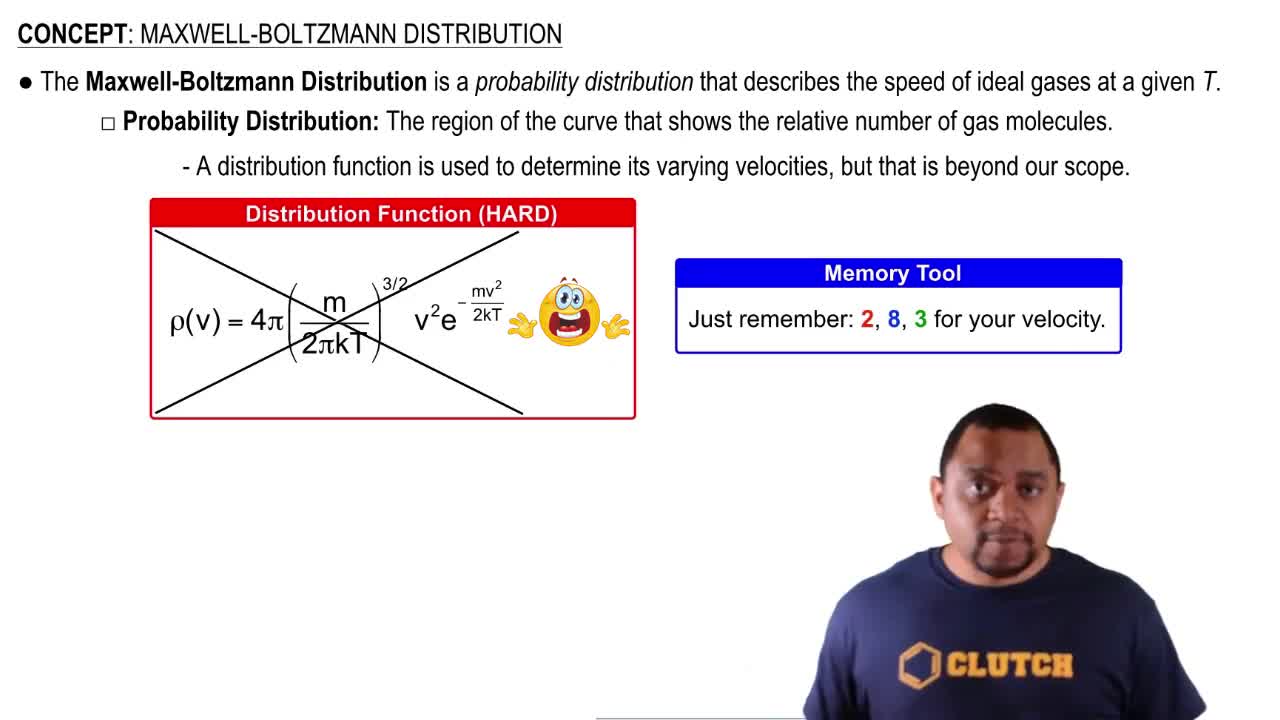
Boltzmann Distribution

The Boltzmann distribution describes the distribution of energies among molecules in a system at thermal equilibrium. It shows that at higher temperatures, a greater fraction of molecules possess energies that exceed the activation energy, which is essential for calculating the fraction of molecules capable of reacting at different temperatures.
Video consigliato:
Percorso guidato
00:54
Maxwell-Boltzmann Distribution

Arrhenius Equation

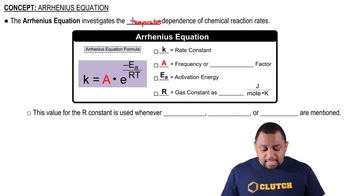
The Arrhenius equation relates the rate constant of a reaction to temperature and activation energy. It can be used to calculate the fraction of molecules with energy equal to or greater than the activation energy by incorporating temperature and activation energy into the equation, allowing for comparisons between different temperatures.
Video consigliato:
Percorso guidato
01:20
Arrhenius Equation