
Ch.14 - Chemical Kinetics
Brown - Chemistry: The Central Science 15th Edition
Brown15th EditionChemistry: The Central ScienceISBN: 9780137542970Non è quello che usi tu?Cambia libro di testo
Capitolo 14, Problema 99c,d

Americium-241 is used in smoke detectors. It has a first-order rate constant for radioactive decay of k = 1.6 * 10-3 yr-1. By contrast, iodine-125, which is used to test for thyroid functioning, has a rate constant for radioactive decay of k = 0.011 day-1. (c) How much of a 1.00-mg sample of each isotope remains after three half-lives? (d) How much of a 1.00-mg sample of each isotope remains after 4 days?

Guida verificata passo dopo passo
1
Step 1: Understand the concept of half-life. In each half-life, half of the remaining radioactive isotope decays. So, after one half-life, half of the original amount remains. After two half-lives, half of the remaining half decays, leaving 1/4 of the original amount. After three half-lives, half of the remaining 1/4 decays, leaving 1/8 of the original amount.
Step 2: Apply this concept to the given problem. We start with a 1.00-mg sample of each isotope. After three half-lives, 1/8 of this original amount remains.
Step 3: Calculate the remaining amount for each isotope. For Americium-241, multiply the original amount (1.00 mg) by 1/8 to find the remaining amount.
Step 4: Repeat the calculation for Iodine-125. Again, multiply the original amount (1.00 mg) by 1/8 to find the remaining amount.
Step 5: Note that the rate constants given in the problem are not needed to solve this part of the problem. The amount remaining after a certain number of half-lives is independent of the specific rate of decay.

Risposta video verificata per un problema simile:

Questa soluzione video è stata consigliata dai nostri tutor come utile per risolvere questo problema.
Durata del video:
5m

Concetti chiave

Ecco i concetti essenziali che devi comprendere per rispondere correttamente alla domanda.

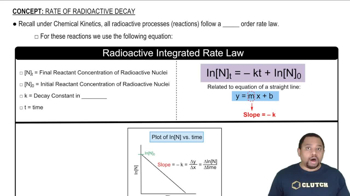
Radioactive Decay

Radioactive decay is the process by which unstable atomic nuclei lose energy by emitting radiation. This decay occurs at a characteristic rate for each isotope, defined by its decay constant (k). The rate of decay is exponential, meaning that the quantity of the substance decreases by a consistent fraction over equal time intervals.
Video consigliato:
Percorso guidato
03:00
Rate of Radioactive Decay

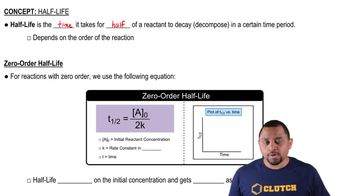
Half-Life

The half-life of a radioactive isotope is the time required for half of the radioactive atoms in a sample to decay. This concept is crucial for understanding how much of a substance remains after a certain period. For any isotope, after one half-life, 50% of the original amount remains; after two half-lives, 25% remains, and so on.
Video consigliato:
Percorso guidato
02:17
Zero-Order Half-life

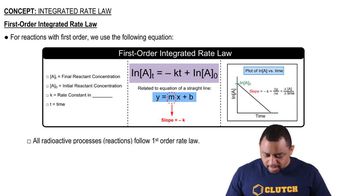
First-Order Kinetics

First-order kinetics refers to a reaction or decay process where the rate is directly proportional to the concentration of one reactant. In the context of radioactive decay, this means that the decay rate of an isotope is constant and independent of the amount present. The relationship can be described mathematically, allowing for the calculation of remaining quantities after a given time.
Video consigliato:
Percorso guidato
02:29
First-Order Reactions
Pratica correlata
Domanda del libro di testo

The rate of a first-order reaction is followed by spectroscopy, monitoring the absorbance of a colored reactant at 520 nm. The reaction occurs in a 1.00-cm sample cell, and the only colored species in the reaction has an extinction coefficient of 5.60 × 10³ M-1 cm-1 at 520 nm.

(d) How long does it take for the absorbance to fall to 0.100?

1061
views
Domanda del libro di testo

Americium-241 is used in smoke detectors. It has a first-order rate constant for radioactive decay of k = 1.6 * 10-3 yr-1. By contrast, iodine-125, which is used to test for thyroid functioning, has a rate constant for radioactive decay of k = 0.011 day-1. (a) What are the half-lives of these two isotopes? (b) Which one decays at a faster rate?

1041
views
Domanda del libro di testo

The rate of a first-order reaction is followed by spectroscopy, monitoring the absorbance of a colored reactant at 520 nm. The reaction occurs in a 1.00-cm sample cell, and the only colored species in the reaction has an extinction coefficient of 5.60 × 10³ M-1 cm-1 at 520 nm.

(a) Calculate the initial concentration of the colored reactant if the absorbance is 0.605 at the beginning of the reaction.

304
views
Domanda del libro di testo

The rate of a first-order reaction is followed by spectroscopy, monitoring the absorbance of a colored reactant at 520 nm. The reaction occurs in a 1.00-cm sample cell, and the only colored species in the reaction has an extinction coefficient of 5.60 × 10³ M-1 cm-1 at 520 nm.

(c) Calculate the half-life of the reaction.

370
views