Ch.14 - Chemical Kinetics
Brown - Chemistry: The Central Science 15th Edition
Brown15th EditionChemistry: The Central ScienceISBN: 9780137542970Non è quello che usi tu?Cambia libro di testo
Capitolo 14, Problema 25b

(b) The reaction 2 NO1g2 + Cl21g2¡2 NOCl1g2 is carried out in a closed vessel. If the partial pressure of NO is decreasing at the rate of 56 torr/min, what is the rate of change of the total pressure of the vessel?

Guida verificata passo dopo passo
1
Identify the stoichiometry of the reaction: For every 2 moles of NO and 1 mole of Cl2, 2 moles of NOCl are produced. The reaction can be written as: 2 NO(g) + Cl2(g) → 2 NOCl(g).
Determine the rate of consumption of Cl2 based on the stoichiometry. Since 2 moles of NO react with 1 mole of Cl2, the rate of decrease in Cl2's partial pressure will be half the rate of decrease of NO's partial pressure.
Calculate the rate of formation of NOCl. According to the stoichiometry, 2 moles of NOCl are formed for every 2 moles of NO consumed. Thus, the rate of increase in NOCl's partial pressure will be equal to the rate of decrease of NO's partial pressure.
Sum up the rates of change in partial pressures. The total pressure change in the vessel is the sum of the rate of decrease of NO and Cl2 partial pressures and the rate of increase of NOCl partial pressure.
Apply the ideal gas law if necessary, considering the volume and temperature are constant in a closed vessel, to relate the changes in partial pressures directly to changes in the number of moles of gases.

Risposta video verificata per un problema simile:

Questa soluzione video è stata consigliata dai nostri tutor come utile per risolvere questo problema.
Durata del video:
3m

Concetti chiave

Ecco i concetti essenziali che devi comprendere per rispondere correttamente alla domanda.

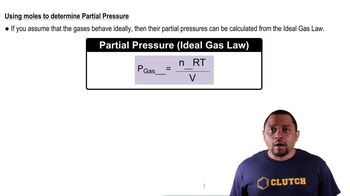
Partial Pressure

Partial pressure is the pressure exerted by a single component of a gas mixture. According to Dalton's Law, the total pressure of a gas mixture is the sum of the partial pressures of each individual gas. Understanding how partial pressures relate to the total pressure is crucial for analyzing gas reactions and their rates.
Video consigliato:
Percorso guidato
00:48
Partial Pressure Calculation

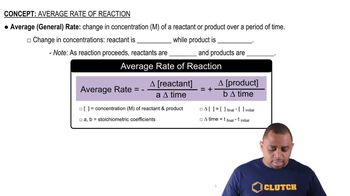
Rate of Reaction

The rate of reaction refers to the change in concentration of reactants or products over time. In this context, the rate at which the partial pressure of NO is decreasing indicates how quickly the reaction is proceeding. This rate can be used to determine the changes in total pressure based on stoichiometric relationships in the balanced chemical equation.
Video consigliato:
Percorso guidato
02:03
Average Rate of Reaction

Stoichiometry

Stoichiometry involves the quantitative relationships between reactants and products in a chemical reaction. In the given reaction, the stoichiometric coefficients indicate that for every 2 moles of NO consumed, 2 moles of NOCl are produced. This relationship is essential for calculating how changes in the concentration or pressure of one component affect the total pressure in the system.
Video consigliato:
Percorso guidato
01:16
Stoichiometry Concept