
Ch.14 - Chemical Kinetics
Brown - Chemistry: The Central Science 15th Edition
Brown15th EditionChemistry: The Central ScienceISBN: 9780137542970Non è quello che usi tu?Cambia libro di testo
Capitolo 14, Problema 46

From the following data for the first-order gas-phase isomerization of CH3NC to CH3CN at 215°C, calculate the first-order rate constant and half-life for the reaction:
Time (s) Pressure CH3NC (torr)
0 502
2000 335
5000 180
8000 95.5
12,000 41.7
15,000 22.4

Guida verificata passo dopo passo
1
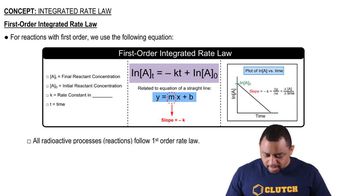
Identify that the reaction is a first-order reaction, which means the rate law is given by \( \ln [A]_t = -kt + \ln [A]_0 \), where \([A]_t\) is the concentration (or pressure) at time \(t\), \([A]_0\) is the initial concentration (or pressure), and \(k\) is the rate constant.
Use the data provided to calculate the rate constant \(k\). Choose two data points, for example, at \(t = 0\) and \(t = 2000\) seconds. Substitute these values into the first-order rate equation: \( \ln(335) = -k(2000) + \ln(502) \).
Rearrange the equation to solve for \(k\): \( k = \frac{\ln(502) - \ln(335)}{2000} \).
Calculate the half-life of the reaction using the formula for the half-life of a first-order reaction: \( t_{1/2} = \frac{0.693}{k} \).
Verify the consistency of the calculated rate constant \(k\) by using another set of data points, such as \(t = 5000\) and \(t = 8000\), and check if the calculated \(k\) is approximately the same.

Risposta video verificata per un problema simile:

Questa soluzione video è stata consigliata dai nostri tutor come utile per risolvere questo problema.
Durata del video:
4m

Concetti chiave

Ecco i concetti essenziali che devi comprendere per rispondere correttamente alla domanda.

First-Order Reactions

First-order reactions are chemical reactions where the rate is directly proportional to the concentration of one reactant. This means that as the concentration of the reactant decreases, the rate of the reaction also decreases. The rate law for a first-order reaction can be expressed as rate = k[A], where k is the rate constant and [A] is the concentration of the reactant.
Video consigliato:
Percorso guidato
02:29
First-Order Reactions

Rate Constant (k)

The rate constant (k) is a proportionality factor in the rate equation that is specific to a given reaction at a particular temperature. For first-order reactions, the rate constant can be determined using the integrated rate law, which relates the concentration of the reactant to time. The units of k for a first-order reaction are typically s⁻¹.
Video consigliato:
Percorso guidato
01:14
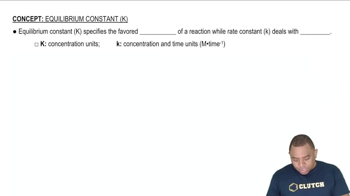
Equilibrium Constant K

Half-Life (t1/2)

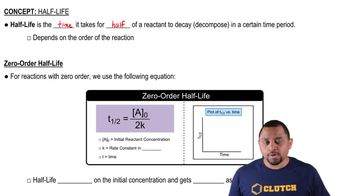
The half-life of a reaction is the time required for the concentration of a reactant to decrease to half of its initial value. For first-order reactions, the half-life is constant and does not depend on the initial concentration, calculated using the formula t1/2 = 0.693/k. This property is useful for predicting how long it will take for a reaction to reach a certain extent of completion.
Video consigliato:
Percorso guidato
02:17
Zero-Order Half-life