Ch.14 - Chemical Kinetics
Brown - Chemistry: The Central Science 15th Edition
Brown15th EditionChemistry: The Central ScienceISBN: 9780137542970Non è quello che usi tu?Cambia libro di testo
Capitolo 14, Problema 9

Hydrogen sulfide (H2S) is a common and troublesome pollutant in industrial wastewaters. One way to remove H2S is to treat the water with chlorine, in which case the following reaction occurs: H2S(aq) + Cl2(aq) → S(s) + 2 H+(aq) + 2 Cl-(aq). The rate of this reaction is first order in each reactant. The rate constant for the disappearance of H2S at 28°C is 3.5 * 10^-2 M^-1 s^-1. If at a given time the concentration of H2S is 2.0 * 10^-4 M and that of Cl2 is 0.025 M, what is the rate of formation of Cl-?

Guida verificata passo dopo passo
1
Step 1: Understand the rate law for the reaction. Since the reaction is first order in each reactant, the rate law can be expressed as: rate = k[H2S][Cl2], where k is the rate constant.
Step 2: Identify the given values. The rate constant k is 3.5 * 10^-2 M^-1 s^-1, the concentration of H2S is 2.0 * 10^-4 M, and the concentration of Cl2 is 0.025 M.
Step 3: Substitute the given values into the rate law equation to find the rate of the reaction: rate = (3.5 * 10^-2 M^-1 s^-1)(2.0 * 10^-4 M)(0.025 M).
Step 4: Recognize that the rate of formation of Cl- is related to the rate of the reaction. According to the balanced chemical equation, 2 moles of Cl- are produced for every mole of H2S that reacts.
Step 5: Calculate the rate of formation of Cl- by multiplying the rate of the reaction by 2, since 2 moles of Cl- are formed per mole of H2S consumed.

Concetti chiave

Ecco i concetti essenziali che devi comprendere per rispondere correttamente alla domanda.

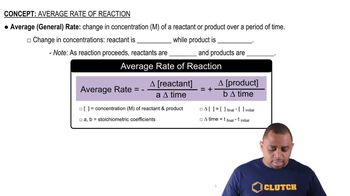
Reaction Rate

The reaction rate is a measure of how quickly reactants are converted into products in a chemical reaction. It is often expressed in terms of the change in concentration of a reactant or product over time. In this case, the rate of the reaction is first order with respect to both H2S and Cl2, meaning that the rate depends linearly on the concentration of each reactant.
Video consigliato:
Percorso guidato
02:03
Average Rate of Reaction

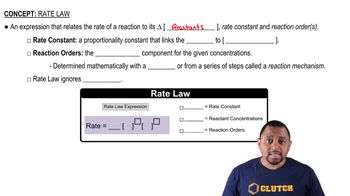
Rate Law

The rate law is an equation that relates the rate of a chemical reaction to the concentration of its reactants, each raised to a power corresponding to its order in the reaction. For the given reaction, the rate law can be expressed as rate = k[H2S][Cl2], where k is the rate constant. This relationship allows us to calculate the rate of formation of products based on the concentrations of the reactants.
Video consigliato:
Percorso guidato
01:52
Rate Law Fundamentals

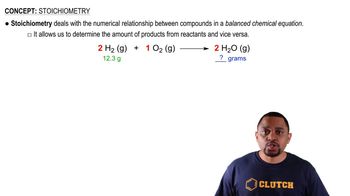
Stoichiometry

Stoichiometry involves the quantitative relationships between the amounts of reactants and products in a chemical reaction. In the provided reaction, the stoichiometry indicates that for every mole of H2S that reacts, two moles of Cl- are produced. This relationship is crucial for determining the rate of formation of Cl- based on the rate of the reaction and the concentrations of the reactants.
Video consigliato:
Percorso guidato
01:16
Stoichiometry Concept
Pratica correlata
Domanda del libro di testo

Given the following diagrams at 𝑡=0 min and 𝑡=30 min, b. After four half-life periods for a first-order reaction, what fraction of reactant remains? [Section 14.3]

Domanda del libro di testo

The following graph shows two different reaction pathways for the same overall reaction at the same temperature. Is each of the following statements true or false? (b) For both paths, the rate of the reverse reaction is slower than the rate of the forward reaction.

1157
views
Domanda del libro di testo

The accompanying graph shows plots of ln k versus 1/𝑇 for two different reactions. The plots have been extrapolated to the y-intercepts. Which reaction (red or blue) has b. the larger value for the frequency factor, A? [Section 14.4]

Domanda del libro di testo

The following diagrams represent mixtures of NO(g) and O2(𝑔). These two substances react as follows:

2 NO(𝑔)+O2(𝑔)⟶2 NO2(𝑔)

It has been determined experimentally that the rate is second order in NO and first order in O2. Based on this fact, which of the following mixtures will have the fastest initial rate? [Section 14.2]

1
views
Domanda del libro di testo

Which of the following linear plots do you expect for a reaction A⟶products if the kinetics are a. zero order, [Section 14.3]

Domanda del libro di testo

The accompanying graph shows plots of ln k versus 1>T for two different reactions. The plots have been extrapolated to the y-intercepts. Which reaction (red or blue) has (a) the larger value for Ea,

706
views