Ch.14 - Chemical Kinetics
Brown - Chemistry: The Central Science 15th Edition
Brown15th EditionChemistry: The Central ScienceISBN: 9780137542970Non è quello che usi tu?Cambia libro di testo
Capitolo 14, Problema 58c

Indicate whether each statement is true or false. (c) If you double the temperature for a reaction, you cut the activation energy in half.

Guida verificata passo dopo passo
1
Understand the concept of activation energy, which is the minimum energy required for a chemical reaction to occur.
Recognize that activation energy is a fixed value for a given reaction and is determined by the nature of the reactants and the reaction pathway.
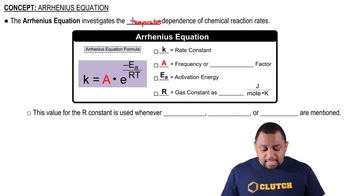
Consider the effect of temperature on reaction rate, which is described by the Arrhenius equation: k = A e^{-E_a/(RT)}, where k is the rate constant, A is the frequency factor, E_a is the activation energy, R is the gas constant, and T is the temperature in Kelvin.
Analyze the statement: Doubling the temperature does not directly alter the activation energy (E_a) itself, but it affects the rate constant (k) by increasing the number of molecules that have enough energy to overcome the activation energy barrier.
Conclude that the statement is false because doubling the temperature of a reaction does not change the activation energy value; it only increases the fraction of molecules that can overcome this energy barrier, thereby increasing the reaction rate.

Risposta video verificata per un problema simile:

Questa soluzione video è stata consigliata dai nostri tutor come utile per risolvere questo problema.
Durata del video:
1m

Concetti chiave

Ecco i concetti essenziali che devi comprendere per rispondere correttamente alla domanda.

Activation Energy

Activation energy is the minimum energy required for a chemical reaction to occur. It represents the energy barrier that reactants must overcome to transform into products. Lowering the activation energy can increase the rate of a reaction, making it easier for reactants to collide with sufficient energy.
Video consigliato:
Percorso guidato
02:02
Activity Series Chart

Temperature and Reaction Rate

Temperature plays a crucial role in chemical reactions, as it affects the kinetic energy of molecules. Generally, increasing the temperature increases the reaction rate because molecules move faster, leading to more frequent and effective collisions. However, temperature does not directly alter the activation energy itself.
Video consigliato:
Percorso guidato
02:03
Average Rate of Reaction

Arrhenius Equation

The Arrhenius equation describes the relationship between the rate constant of a reaction and temperature, incorporating activation energy. It shows that the rate constant increases exponentially with an increase in temperature, but it does not imply that doubling the temperature halves the activation energy. Instead, it indicates that higher temperatures can enhance reaction rates without changing the inherent activation energy.
Video consigliato:
Percorso guidato
01:20
Arrhenius Equation