
Ch.14 - Chemical Kinetics
Brown - Chemistry: The Central Science 15th Edition
Brown15th EditionChemistry: The Central ScienceISBN: 9780137542970Non è quello che usi tu?Cambia libro di testo
Capitolo 14, Problema 50a

Sucrose 1C12H22O112, commonly known as table sugar, reacts in dilute acid solutions to form two simpler sugars, glucose and fructose, both of which have the formula C6H12O6. At 23 C and in 0.5 M HCl, the following data were obtained for the disappearance of sucrose: Time (min) 3C12H22o11 4 1M2 0 0.316 39 0.274 80 0.238 140 0.190 210 0.146 (a) Is the reaction first order or second order with respect to 3C12H22O114?

Guida verificata passo dopo passo
1
We need to determine the order of the reaction with respect to sucrose (C_{12}H_{22}O_{11}). The data provided shows the concentration of sucrose at different times. We will use this data to determine if the reaction is first order or second order.
For a first-order reaction, the rate law is: \( \text{Rate} = k [\text{C}_{12}\text{H}_{22}\text{O}_{11}] \). For a second-order reaction, the rate law is: \( \text{Rate} = k [\text{C}_{12}\text{H}_{22}\text{O}_{11}]^2 \).
For a first-order reaction, the integrated rate law is: \( \ln [\text{C}_{12}\text{H}_{22}\text{O}_{11}] = -kt + \ln [\text{C}_{12}\text{H}_{22}\text{O}_{11}]_0 \). For a second-order reaction, the integrated rate law is: \( \frac{1}{[\text{C}_{12}\text{H}_{22}\text{O}_{11}]} = kt + \frac{1}{[\text{C}_{12}\text{H}_{22}\text{O}_{11}]_0} \).
Plot \( \ln [\text{C}_{12}\text{H}_{22}\text{O}_{11}] \) versus time for a first-order reaction and \( \frac{1}{[\text{C}_{12}\text{H}_{22}\text{O}_{11}]} \) versus time for a second-order reaction. The plot that results in a straight line indicates the order of the reaction.
Determine which plot is linear. If the plot of \( \ln [\text{C}_{12}\text{H}_{22}\text{O}_{11}] \) versus time is linear, the reaction is first order. If the plot of \( \frac{1}{[\text{C}_{12}\text{H}_{22}\text{O}_{11}]} \) versus time is linear, the reaction is second order.>

Risposta video verificata per un problema simile:

Questa soluzione video è stata consigliata dai nostri tutor come utile per risolvere questo problema.
Durata del video:
2m

Concetti chiave

Ecco i concetti essenziali che devi comprendere per rispondere correttamente alla domanda.

Reaction Order

Reaction order refers to the power to which the concentration of a reactant is raised in the rate law of a chemical reaction. It indicates how the rate of reaction depends on the concentration of reactants. A first-order reaction has a linear relationship between the concentration of one reactant and the rate, while a second-order reaction involves a squared concentration term, indicating a more complex relationship.
Video consigliato:
Percorso guidato
00:36
Average Bond Order

Rate Law

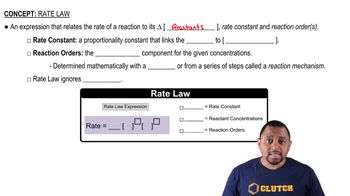
The rate law is an equation that relates the rate of a chemical reaction to the concentration of its reactants. It is typically expressed in the form Rate = k[A]^m[B]^n, where k is the rate constant, and m and n are the orders of the reaction with respect to reactants A and B. Determining the rate law is essential for understanding how changes in concentration affect the speed of the reaction.
Video consigliato:
Percorso guidato
01:52
Rate Law Fundamentals

Integrated Rate Laws

Integrated rate laws provide a mathematical relationship between the concentration of reactants and time, allowing for the determination of reaction order through experimental data. For first-order reactions, the integrated form is ln[A] = -kt + ln[A]0, while for second-order reactions, it is 1/[A] = kt + 1/[A]0. Analyzing concentration versus time data using these equations helps identify the order of the reaction.
Video consigliato:
Percorso guidato
01:52
Rate Law Fundamentals