Ch.14 - Chemical Kinetics
Brown - Chemistry: The Central Science 15th Edition
Brown15th EditionChemistry: The Central ScienceISBN: 9780137542970Non è quello che usi tu?Cambia libro di testo
Capitolo 14, Problema 94

The following kinetic data are collected for the initial rates of a reaction 2X + Z → products: Experiment [X] (M) [Z] (M) Rate (M/s) 1 0.25 0.25 4.0 * 10^1 2 0.50 0.50 3.2 * 10^2 3 0.50 0.75 7.2 * 10^2. (c) What is the reaction rate when the initial concentration of X is 0.75 M and that of Z is 1.25 M?

Guida verificata passo dopo passo
1
Step 1: Determine the rate law expression for the reaction. The general form of the rate law is Rate = k[X]^m[Z]^n, where k is the rate constant, and m and n are the orders of the reaction with respect to X and Z, respectively.
Step 2: Use the data from experiments 1 and 2 to find the order of the reaction with respect to X. Compare the rates and concentrations of X while keeping Z constant to solve for m.
Step 3: Use the data from experiments 2 and 3 to find the order of the reaction with respect to Z. Compare the rates and concentrations of Z while keeping X constant to solve for n.
Step 4: Calculate the rate constant k using the rate law expression and the data from one of the experiments, now that m and n are known.
Step 5: Substitute the given concentrations of X (0.75 M) and Z (1.25 M) into the rate law expression to calculate the reaction rate.

Concetti chiave

Ecco i concetti essenziali che devi comprendere per rispondere correttamente alla domanda.

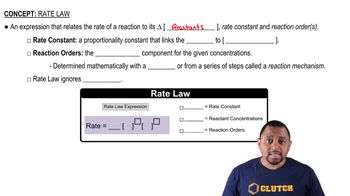
Rate Law

The rate law expresses the relationship between the rate of a chemical reaction and the concentration of its reactants. It is typically formulated as Rate = k[A]^m[B]^n, where k is the rate constant, [A] and [B] are the concentrations of the reactants, and m and n are the reaction orders with respect to each reactant. Understanding the rate law is essential for predicting how changes in concentration affect the reaction rate.
Video consigliato:
Percorso guidato
01:52
Rate Law Fundamentals

Reaction Order

Reaction order refers to the exponent to which the concentration of a reactant is raised in the rate law. It indicates how the rate of reaction is affected by the concentration of that reactant. For example, if the reaction is first order with respect to X, doubling the concentration of X will double the rate of reaction. Determining the reaction order is crucial for calculating the rate under different concentrations.
Video consigliato:
Percorso guidato
00:36
Average Bond Order

Method of Initial Rates

The method of initial rates involves measuring the initial rate of reaction at various concentrations of reactants to deduce the rate law and reaction orders. By analyzing how the rate changes with different concentrations, one can derive the exponents in the rate law. This method is particularly useful in experimental kinetics to establish the relationship between concentration and reaction rate.
Video consigliato:
Percorso guidato
01:15
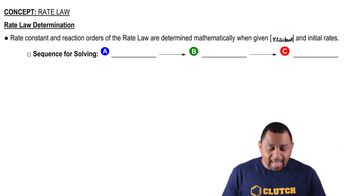
Rate Law Determination
Pratica correlata
Domanda del libro di testo

The reaction 2 NO2 → 2 NO + O2 has the rate constant k = 0.63 M-1s-1. (a) Based on the units for k, is the reaction first or second order in NO2?

Domanda del libro di testo

The reaction 2 NO(g) + O2(g) → 2 NO2 (g) is second order in NO and first order in O2. When [NO] = 0.040 M, and [O2] = 0.035 M, the observed rate of disappearance of NO is 9.3⨉10-5 M/s. (d) What would happen to the rate if the concentration of NO were increased by a factor of 1.8?

Domanda del libro di testo

Consider two reactions. Reaction (1) has a constant halflife, whereas reaction (2) has a half-life that gets longer as the reaction proceeds. What can you conclude about the rate laws of these reactions from these observations?

588
views
Domanda del libro di testo

The reaction 2 NO2 → 2 NO + O2 has the rate constant k = 0.63 M-1s-1.

(b) If the initial concentration of NO2 is 0.100 M, how would you determine how long it would take for the concentration to decrease to 0.025 M?

1326
views
Domanda del libro di testo

Consider the following reaction between mercury(II) chloride and oxalate ion:

2 HgCl2(aq) + C2O42-(aq) → 2 Cl-(aq) + 2 CO2(g) + Hg2Cl2(s)

The initial rate of this reaction was determined for several concentrations of HgCl2 and C2O42-, and the following rate data were obtained for the rate of disappearance of C2O42-:

Experiment [HgCl2] (M) [C2O42-] (M) Rate (M/s)

1 0.164 0.15 3.2 × 10⁻⁵

2 0.164 0.45 2.9 × 10⁻⁴

3 0.082 0.45 1.4 × 10⁻⁴

4 0.246 0.15 4.8 × 10⁻⁵

(b) What is the value of the rate constant with proper units?

(c) What is the reaction rate when the initial concentration of HgCl2 is 0.100 M and that of C2O42- is 0.25 M if the temperature is the same as that used to obtain the data shown?

1291
views