Ch.14 - Chemical Kinetics
Brown - Chemistry: The Central Science 15th Edition
Brown15th EditionChemistry: The Central ScienceISBN: 9780137542970Non è quello che usi tu?Cambia libro di testo
Capitolo 14, Problema 22d

The rate of disappearance of HCl was measured for the following reaction: CH3OH1aq2 + HCl1aq2¡CH3Cl1aq2 + H2O1l2 The following data were collected: Time (min) 3HCl 4 1M2 0.0 1.85 54.0 1.58 107.0 1.36 215.0 1.02 430.0 0.580 (d) Graph [HCl] versus time and determine the instantaneous rates in M>min and M>s at t = 75.0 min and t = 250 min.

Guida verificata passo dopo passo
1
Plot the concentration of HCl ([HCl]) on the y-axis against time (in minutes) on the x-axis using the provided data points.
Draw a smooth curve that best fits the plotted data points to represent the change in [HCl] over time.
To find the instantaneous rate at t = 75.0 min, draw a tangent line to the curve at this point and determine the slope of this tangent line. The slope will give the rate in M/min.
Repeat the process for t = 250 min by drawing a tangent line to the curve at this point and calculating the slope to find the rate in M/min.
Convert the rates from M/min to M/s by dividing the rates by 60, since there are 60 seconds in a minute.

Risposta video verificata per un problema simile:

Questa soluzione video è stata consigliata dai nostri tutor come utile per risolvere questo problema.
Durata del video:
6m

Concetti chiave

Ecco i concetti essenziali che devi comprendere per rispondere correttamente alla domanda.

Reaction Rate

The reaction rate is a measure of how quickly reactants are converted into products in a chemical reaction. It can be expressed in terms of the change in concentration of a reactant or product over time, typically in units of molarity per minute (M/min). Understanding how to calculate and interpret reaction rates is essential for analyzing kinetic data and determining the speed of a reaction.
Video consigliato:
Percorso guidato
02:03
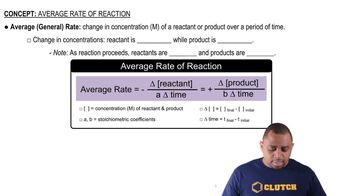
Average Rate of Reaction

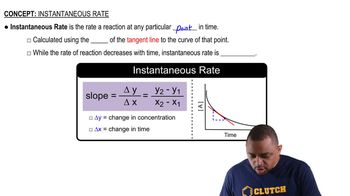
Instantaneous Rate

The instantaneous rate of a reaction refers to the rate at a specific moment in time, rather than over an interval. It can be determined by taking the slope of the tangent line to the concentration versus time graph at the desired time point. This concept is crucial for understanding how the rate of reaction changes as the reactants are consumed and products are formed.
Video consigliato:
Percorso guidato
01:30
Instantaneous Rate

Graphing Concentration vs. Time

Graphing the concentration of a reactant or product against time allows for visual analysis of the reaction's progress. The shape of the graph can indicate the order of the reaction and help identify trends in concentration changes. This graphical representation is vital for determining both average and instantaneous rates, as well as for predicting future concentrations at given times.
Video consigliato:
Percorso guidato
03:12
Precipitation: Ksp vs Q Example
Pratica correlata
Domanda del libro di testo

The rate of disappearance of HCl was measured for the following reaction: CH3OH1aq2 + HCl1aq2¡CH3Cl1aq2 + H2O1l2 The following data were collected: Time (min) 3HCl 4 1M2 0.0 1.85 54.0 1.58 107.0 1.36 215.0 1.02 430.0 0.580 (b) Calculate the average rate of reaction for the entire time for the data from t = 0.0 min to t = 430.0 min.

790
views
Domanda del libro di testo

For each of the following gas-phase reactions, indicate how the rate of disappearance of each reactant is related to the rate of appearance of each product:

(d) C2H5NH2(g) → C2H4(g) + NH3(g)

110
views
Domanda del libro di testo

For each of the following gas-phase reactions, indicate how the rate of disappearance of each reactant is related to the rate of appearance of each product:

(a) H2O2(g) → H2(g) + O2(g)

(b) 2 N2O(g) → 2 N2(g) + O2(g)

110
views
Domanda del libro di testo

The rate of disappearance of HCl was measured for the following reaction: CH3OH1aq2 + HCl1aq2¡CH3Cl1aq2 + H2O1l2 The following data were collected: Time (min) 3HCl 4 1M2 0.0 1.85 54.0 1.58 107.0 1.36 215.0 1.02 430.0 0.580 (a) Calculate the average rate of reaction, in M>s, for the time interval between each measurement.

555
views
Domanda del libro di testo

The rate of disappearance of HCl was measured for the following reaction: CH3OH1aq2 + HCl1aq2¡CH3Cl1aq2 + H2O1l2 The following data were collected: Time (min) 3HCl 4 1M2 0.0 1.85 54.0 1.58 107.0 1.36 215.0 1.02 430.0 0.580 (c) Which is greater, the average rate between t = 54.0 and t = 215.0 min, or between t = 107.0 and t = 430.0 min?

363
views
Domanda del libro di testo

For each of the following gas-phase reactions, indicate how the rate of disappearance of each reactant is related to the rate of appearance of each product: (c) N21g2 + 3 H21g2¡2 NH31g2

2056
views