Ch.14 - Chemical Kinetics
Brown - Chemistry: The Central Science 15th Edition
Brown15th EditionChemistry: The Central ScienceISBN: 9780137542970Non è quello che usi tu?Cambia libro di testo
Capitolo 14, Problema 91c

The reaction 2 NO(g) + O2(g) → 2 NO2 (g) is second order in NO and first order in O2. When [NO] = 0.040 M, and [O2] = 0.035 M, the observed rate of disappearance of NO is 9.3⨉10-5 M/s. (c) What are the units of the rate constant?

Guida verificata passo dopo passo
1
Determine the rate law expression for the reaction. Since the reaction is second order in NO and first order in O_2, the rate law is: rate = k[NO]^2[O_2]^1.
Identify the units of the rate of reaction. The rate of reaction is given in M/s (molarity per second).
Use the rate law expression to determine the units of the rate constant k. Rearrange the rate law to solve for k: k = rate / ([NO]^2[O_2]).
Substitute the units into the rearranged rate law expression: k = (M/s) / (M^2 * M).
Simplify the units to find the units of the rate constant k. The units of k will be M^(-2) * s^(-1).

Risposta video verificata per un problema simile:

Questa soluzione video è stata consigliata dai nostri tutor come utile per risolvere questo problema.
Durata del video:
5m

Concetti chiave

Ecco i concetti essenziali che devi comprendere per rispondere correttamente alla domanda.

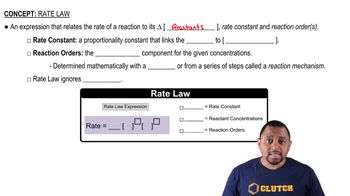
Rate Law

The rate law expresses the relationship between the rate of a chemical reaction and the concentration of its reactants. It is typically formulated as rate = k[A]^m[B]^n, where k is the rate constant, A and B are the reactants, and m and n are their respective orders. Understanding the rate law is essential for determining how changes in concentration affect the reaction rate.
Video consigliato:
Percorso guidato
01:52
Rate Law Fundamentals

Order of Reaction

The order of a reaction refers to the power to which the concentration of a reactant is raised in the rate law. It indicates how the rate of reaction is affected by the concentration of that reactant. In the given reaction, NO is second order and O2 is first order, meaning the rate is more sensitive to changes in [NO] than in [O2].
Video consigliato:
Percorso guidato
00:36
Average Bond Order

Units of the Rate Constant (k)

The units of the rate constant depend on the overall order of the reaction. For a reaction that is second order in one reactant and first order in another, the overall order is three. The units of k can be derived from the rate equation, leading to units of M^-2 s^-1 for this specific reaction. Understanding these units is crucial for calculating and interpreting the rate constant.
Video consigliato:
Percorso guidato
01:14
Equilibrium Constant K
Pratica correlata
Domanda del libro di testo

Consider the reaction A + B → C + D. Is each of the following statements true or false? (b) If the reaction is an elementary reaction, the rate law is second order.

374
views

Domanda del libro di testo

The reaction 2 NO(g) + O2(g) → 2 NO2 (g) is second order in NO and first order in O2. When [NO] = 0.040 M, and [O2] = 0.035 M, the observed rate of disappearance of NO is 9.3⨉10-5 M/s. (b) What is the value of the rate constant?

403
views
Domanda del libro di testo

The reaction 2 NO(g) + O2(g) → 2 NO2 (g) is second order in NO and first order in O2. When [NO] = 0.040 M, and [O2] = 0.035 M, the observed rate of disappearance of NO is 9.3⨉10-5 M/s. (d) What would happen to the rate if the concentration of NO were increased by a factor of 1.8?

Domanda del libro di testo

Consider the reaction A + B → C + D. Is each of the following statements true or false? (c) If the reaction is an elementary reaction, the rate law of the reverse reaction is first order.

776
views
Domanda del libro di testo

Consider the following reaction between mercury(II) chloride and oxalate ion:

2 HgCl2(aq) + C2O42-(aq) → 2 Cl-(aq) + 2 CO2(g) + Hg2Cl2(s)

The initial rate of this reaction was determined for several concentrations of HgCl2 and C2O42-, and the following rate data were obtained for the rate of disappearance of C2O42-:

Experiment [HgCl2] (M) [C2O42-] (M) Rate (M/s)

1 0.164 0.15 3.2 × 10⁻⁵

2 0.164 0.45 2.9 × 10⁻⁴

3 0.082 0.45 1.4 × 10⁻⁴

4 0.246 0.15 4.8 × 10⁻⁵

(b) What is the value of the rate constant with proper units?

(c) What is the reaction rate when the initial concentration of HgCl2 is 0.100 M and that of C2O42- is 0.25 M if the temperature is the same as that used to obtain the data shown?

1291
views