Ch.14 - Chemical Kinetics
Brown - Chemistry: The Central Science 15th Edition
Brown15th EditionChemistry: The Central ScienceISBN: 9780137542970Non è quello che usi tu?Cambia libro di testo
Capitolo 14, Problema 68a,b

What is the molecularity of each of the following elementary reactions? Write the rate law for each.
(a) 2 NO(g) → N2O2(g)
(c) SO3(g) → SO2(g) + O(g)

Guida verificata passo dopo passo
1
insert step 1> Identify the number of reactant molecules involved in the elementary reaction. In this case, the reaction is 2 NO(g) → N_2O_2(g), which involves two NO molecules.
insert step 2> Determine the molecularity of the reaction. Molecularity refers to the number of reactant molecules involved in an elementary reaction. Since there are two NO molecules, the reaction is bimolecular.
insert step 3> Write the rate law for the elementary reaction. For a bimolecular reaction involving two identical molecules, the rate law is expressed as rate = k[NO]^2, where k is the rate constant.
insert step 4> Understand that the rate law for an elementary reaction is directly based on its molecularity, which is why the concentration of NO is squared in the rate law.
insert step 5> Remember that molecularity is only applicable to elementary reactions, and it provides a straightforward way to write the rate law based on the stoichiometry of the reactants.

Risposta video verificata per un problema simile:

Questa soluzione video è stata consigliata dai nostri tutor come utile per risolvere questo problema.
Durata del video:
1m

Concetti chiave

Ecco i concetti essenziali che devi comprendere per rispondere correttamente alla domanda.

Molecularity

Molecularity refers to the number of reactant molecules involved in an elementary reaction. It can be classified as unimolecular (one molecule), bimolecular (two molecules), or termolecular (three molecules). In the case of the reaction 2 NO(g) → N2O2(g), the molecularity is bimolecular because two NO molecules are involved in the reaction.
Video consigliato:
Percorso guidato
02:38
Molecular Polarity

Rate Law

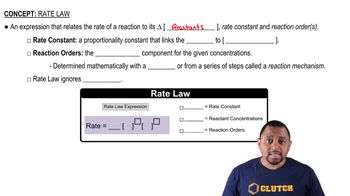
The rate law expresses the relationship between the rate of a chemical reaction and the concentration of its reactants. For elementary reactions, the rate law can be directly derived from the stoichiometry of the reaction. For the reaction 2 NO(g) → N2O2(g), the rate law is given by rate = k[NO]^2, where k is the rate constant and [NO] is the concentration of nitric oxide.
Video consigliato:
Percorso guidato
01:52
Rate Law Fundamentals

Elementary Reaction

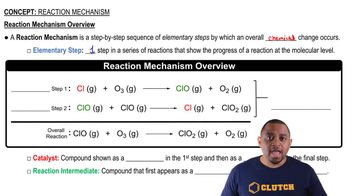
An elementary reaction is a single step process in a chemical reaction mechanism where reactants are converted to products in one step. The rate of an elementary reaction is directly proportional to the concentrations of the reactants raised to the power of their coefficients in the balanced equation. Understanding elementary reactions is crucial for determining molecularity and writing accurate rate laws.
Video consigliato:
Percorso guidato
03:06
Reaction Mechanism Overview