
Ch.14 - Chemical Kinetics
Brown - Chemistry: The Central Science 15th Edition
Brown15th EditionChemistry: The Central ScienceISBN: 9780137542970Non è quello che usi tu?Cambia libro di testo
Capitolo 14, Problema 74b

You have studied the gas-phase oxidation of HBr by O2: 4 HBr(g) + O2(g) → 2 H2O(g) + 2 Br2(g)
You find the reaction to be first order with respect to HBr and first order with respect to O2. You propose the following mechanism:
HBr(g) + O2(g) → HOOBr(g)
HOOBr(g) + HBr(g) → 2 HOBr(g)
HOBr(g) + HBr(g) → H2O(g) + Br2(g)
(b) Based on the experimentally determined rate law, which step is rate determining?

Guida verificata passo dopo passo
1
1. The rate law for a reaction is determined by the slowest step in the reaction mechanism, also known as the rate-determining step. The rate law is an expression that shows the relationship between the rate of a reaction and the concentrations of the reactants.
2. The problem states that the reaction is first order with respect to HBr and first order with respect to O2. This means that the rate of the reaction depends on the concentration of HBr and O2 to the first power.
3. Looking at the proposed mechanism, the first step involves one molecule of HBr and one molecule of O2. This step is consistent with the experimentally determined rate law, as it involves one molecule of each reactant.
4. The second and third steps in the mechanism only involve HBr and other species, but not O2. Therefore, these steps cannot be the rate-determining step because the rate law shows that the reaction rate depends on both HBr and O2.
5. Therefore, based on the experimentally determined rate law, the first step (HBr(g) + O2(g) → HOOBr(g)) is the rate-determining step in the reaction mechanism.

Risposta video verificata per un problema simile:

Questa soluzione video è stata consigliata dai nostri tutor come utile per risolvere questo problema.
Durata del video:
4m

Concetti chiave

Ecco i concetti essenziali che devi comprendere per rispondere correttamente alla domanda.

Rate Law

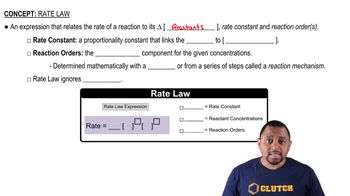
The rate law of a reaction expresses the relationship between the rate of a chemical reaction and the concentration of its reactants. It is determined experimentally and indicates how the rate depends on the concentration of each reactant, often represented as rate = k[A]^m[B]^n, where k is the rate constant, and m and n are the orders of the reaction with respect to reactants A and B, respectively.
Video consigliato:
Percorso guidato
01:52
Rate Law Fundamentals

Rate Determining Step (RDS)

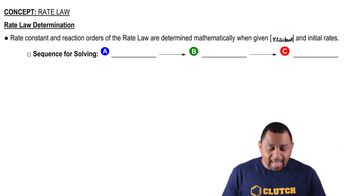
The rate determining step is the slowest step in a reaction mechanism that dictates the overall rate of the reaction. It is crucial because even if other steps are faster, the RDS limits how quickly the entire reaction can proceed. Identifying the RDS helps in understanding the kinetics of the reaction and is often inferred from the rate law.
Video consigliato:
Percorso guidato
01:15
Rate Law Determination

Mechanism of Reaction

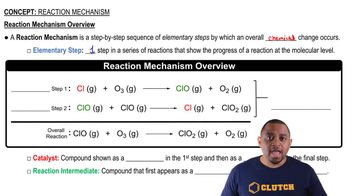
A reaction mechanism is a step-by-step description of the pathway taken by reactants to form products. Each step in the mechanism represents a single molecular event, and the overall reaction is the sum of these steps. Understanding the mechanism is essential for predicting the rate law and identifying the rate determining step, as it provides insight into how reactants interact and transform during the reaction.
Video consigliato:
Percorso guidato
03:06
Reaction Mechanism Overview
Pratica correlata
Domanda del libro di testo

The reaction 2 NO1g2 + Cl21g2¡2 NOCl1g2 was performed and the following data were obtained under conditions of constant 3Cl24:

(a) Is the following mechanism consistent with the data? NO1g2 + Cl21g2ΔNOCl21g2 1fast2 NOCl21g2 + NO1g2¡2 NOCl1g2 1slow2

292
views
Domanda del libro di testo

You have studied the gas-phase oxidation of HBr by O2: 4 HBr(g) + O2(g) → 2 H2O(g) + 2 Br2(g)

You find the reaction to be first order with respect to HBr and first order with respect to O2. You propose the following mechanism:

HBr(g) + O2(g) → HOOBr(g)

HOOBr(g) + HBr(g) → 2 HOBr(g)

HOBr(g) + HBr(g) → H2O(g) + Br2(g)

(a) Confirm that the elementary reactions add to give the overall reaction.

346
views
Domanda del libro di testo

(c) Do catalysts affect the overall enthalpy change for a reaction, the activation energy, or both?

574
views
Domanda del libro di testo

The decomposition of hydrogen peroxide is catalyzed by iodide ion. The catalyzed reaction is thought to proceed by a two-step mechanism:

H2O2(aq) + I-(aq) → H2O(l) + IO-(aq) (slow)

IO-(aq) + H2O2(aq) → H2O(l) + O2(g) + I-(aq) (fast)

(c) Assuming that the first step of the mechanism is rate determining, predict the rate law for the overall process.

1669
views
Domanda del libro di testo

(a) What is a catalyst? (b) What is the difference between a homogeneous and a heterogeneous catalyst?

Domanda del libro di testo

(a) Most commercial heterogeneous catalysts are extremely finely divided solid materials. Why is particle size important?

522
views