Ch.15 - Chemical Equilibrium
Brown - Chemistry: The Central Science 15th Edition
Brown15th EditionChemistry: The Central ScienceISBN: 9780137542970Non è quello che usi tu?Cambia libro di testo
Capitolo 15, Problema 89b

At 700 K, the equilibrium constant for the reaction CCl4(𝑔) ⇌ C(𝑠) + 2 Cl2(𝑔) is 𝐾𝑝 = 0.76. A flask is charged with 2.00 atm of CCl4, which then reaches equilibrium at 700 K. (b) What are the partial pressures of CCl4 and Cl2 at equilibrium?

Guida verificata passo dopo passo
1
Step 1: Write the balanced chemical equation for the reaction: CCl4(g) ⇌ C(s) + 2 Cl2(g).
Step 2: Define the initial pressures of the reactants and products. Initially, the pressure of CCl4 is 2.00 atm, and the pressures of C(s) and Cl2 are 0 atm.
Step 3: Let the change in pressure of CCl4 at equilibrium be -x atm. Since C(s) is a solid, its pressure does not contribute to the equilibrium expression. The change in pressure of Cl2 will be +2x atm.
Step 4: Write the expression for the equilibrium constant, Kp, in terms of the partial pressures of the gases at equilibrium. Kp = (PCl2)^2 / PCCl4.
Step 5: Substitute the expressions for the pressures at equilibrium into the Kp expression and solve for x. Use the quadratic formula if necessary to find the value of x, and then calculate the equilibrium partial pressures of CCl4 and Cl2.

Risposta video verificata per un problema simile:

Questa soluzione video è stata consigliata dai nostri tutor come utile per risolvere questo problema.
Durata del video:
11m

Concetti chiave

Ecco i concetti essenziali che devi comprendere per rispondere correttamente alla domanda.

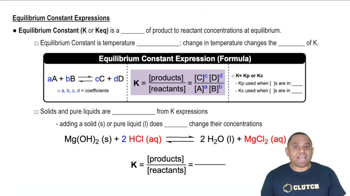
Equilibrium Constant (Kp)

The equilibrium constant (Kp) is a numerical value that expresses the ratio of the partial pressures of the products to the reactants at equilibrium for a given reaction at a specific temperature. For the reaction CCl₄(g) ⇌ C(s) + 2 Cl₂(g), Kp = 0.76 indicates that at equilibrium, the ratio of the pressure of Cl₂ squared to the pressure of CCl₄ is constant. This concept is crucial for determining the concentrations or pressures of reactants and products at equilibrium.
Video consigliato:
Percorso guidato
03:20
Equilibrium Constant Expressions

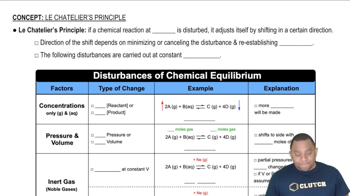
Le Chatelier's Principle

Le Chatelier's Principle states that if a system at equilibrium is disturbed by a change in concentration, temperature, or pressure, the system will adjust to counteract the disturbance and restore a new equilibrium. In this case, if the initial pressure of CCl₄ is altered, the system will shift to either produce more products or reactants to re-establish equilibrium, which is essential for calculating the final partial pressures.
Video consigliato:
Percorso guidato
07:32
Le Chatelier's Principle

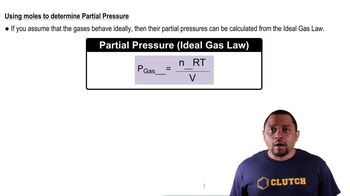
Partial Pressure

Partial pressure is the pressure exerted by a single component of a gas mixture. According to Dalton's Law, the total pressure of a gas mixture is the sum of the partial pressures of each individual gas. In the context of the given reaction, understanding how to calculate the partial pressures of CCl₄ and Cl₂ at equilibrium is necessary to solve the problem, as it involves using the initial conditions and the equilibrium constant.
Video consigliato:
Percorso guidato
00:48
Partial Pressure Calculation
Pratica correlata
Domanda del libro di testo

At 700 K, the equilibrium constant for the reaction CCl4(𝑔) ⇌ C(𝑠) + 2 Cl2(𝑔) is 𝐾𝑝 = 0.76. A flask is charged with 2.00 atm of CCl4, which then reaches equilibrium at 700 K. (a) What fraction of the CCl4 is converted into C and Cl2?

Domanda del libro di testo

At a temperature of 700 K, the forward and reverse rate constants for the reaction 2 HI(g) ⇌ H2(g) + I2(g) are kf = 1.8×10⁻³⁰ M−1s−1 and kr = 0.063 M−1s−1.

(a) What is the value of the equilibrium constant Kc at 700 K?

(b) Is the forward reaction endothermic or exothermic if the rate constants for the same reaction have values of kf = 0.097M−1s−1 and kr = 2.6 M−1s−1 at 800 K?

298
views
Domanda del libro di testo

The equilibrium constant constant 𝐾𝑐 for C(𝑠) + CO2(𝑔) ⇌ 2 CO(𝑔) is 1.9 at 1000 K and 0.133 at 298 K. (a) If excess C is allowed to react with 25.0 g of CO2 in a 3.00-L vessel at 1000 K, how many grams of CO are produced? (b) If excess C is allowed to react with 25.0 g of CO2 in a 3.00-L vessel at 1000 K, how many grams of C are consumed?

954
views
Domanda del libro di testo

Consider the hypothetical reaction A(𝑔) + 2 B(𝑔) ⇌ 2 C(𝑔), for which 𝐾𝑐 = 0.25 at a certain temperature. A 1.00-L reaction vessel is loaded with 1.00 mol of compound C, which is allowed to reach equilibrium. Let the variable x represent the number of mol/L of compound A present at equilibrium.

(d) The equation from part (c) is a cubic equation (one that has the form ax3 + bx2 + cx + d = 0). In general, cubic equations cannot be solved in closed form. However, you can estimate the solution by plotting the cubic equation in the allowed range of x that you specified in part (b). The point at which the cubic equation crosses the x-axis is the solution.

(e) From the plot in part (d), estimate the equilibrium concentrations of A, B, and C. (Hint: You can check the accuracy of your answer by substituting these concentrations into the equilibrium expression.)

521
views