At 1000 K, 𝐾𝑝 = 1.85 for the reaction SO2(𝑔) + 12 O2(𝑔) ⇌ SO3(𝑔) (c) What is the value of 𝐾𝑐 for the reaction in part (b)?
Ch.15 - Chemical Equilibrium

Brown15th EditionChemistry: The Central ScienceISBN: 9780137542970Non è quello che usi tu?Cambia libro di testo
Capitolo 15, Problema 26a
Consider the following equilibrium, for which at 𝐾𝑝 = 0.0752 at 480°C: 2 Cl2(𝑔) + 2 H2O(𝑔) ⇌ 4 HCl(𝑔) + O2(𝑔) (a) What is the value of 𝐾𝑝 for the reaction 4 HCl(𝑔) + O2(𝑔) ⇌ 2 Cl2(𝑔) + 2 H2O(𝑔)?
Guida verificata passo dopo passo1

Risposta video verificata per un problema simile:
Questa soluzione video è stata consigliata dai nostri tutor come utile per risolvere questo problema.
Durata del video:
1mConcetti chiave
Ecco i concetti essenziali che devi comprendere per rispondere correttamente alla domanda.
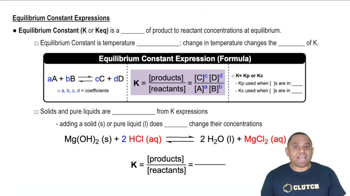
Equilibrium Constant (Kp)
The equilibrium constant, Kp, is a numerical value that expresses the ratio of the concentrations of products to reactants at equilibrium for a given reaction at a specific temperature. It is calculated using the partial pressures of gases involved in the reaction. A Kp value less than 1 indicates that at equilibrium, reactants are favored, while a value greater than 1 indicates that products are favored.
Video consigliato:
Percorso guidato
Equilibrium Constant Expressions
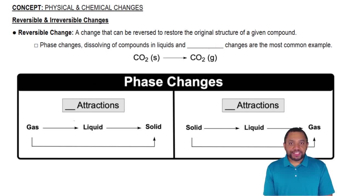
Reversibility of Reactions
Chemical reactions can proceed in both forward and reverse directions, and the equilibrium constant for the reverse reaction is the reciprocal of the forward reaction's equilibrium constant. This means that if you know Kp for a reaction, you can easily find Kp for the reverse reaction by taking the inverse of that value. This principle is crucial for solving equilibrium problems.
Video consigliato:
Percorso guidato
Reversible Changes in Matter
Stoichiometry in Equilibrium
Stoichiometry refers to the quantitative relationship between reactants and products in a chemical reaction, as represented by the balanced equation. In equilibrium expressions, the coefficients of the balanced equation become the exponents in the Kp expression. Understanding stoichiometry is essential for accurately calculating equilibrium constants and predicting the direction of the reaction.
Video consigliato:
Percorso guidato
Stoichiometry Concept
Pratica correlata
Domanda del libro di testo
1089
views
Domanda del libro di testo
Consider the equilibrium N2(𝑔) + O2(𝑔) + Br2(𝑔) ⇌ 2 NOBr(𝑔) Calculate the equilibrium constant 𝐾𝑝 for this reaction, given the following information at 298 K:
2 NO(𝑔) + Br2(𝑔) ⇌ 2 NOBr(𝑔) 𝐾𝑐 = 2.02
NO(𝑔) ⇌ N2(𝑔) + O2(𝑔) 𝐾𝑐 = 2.1×1030
990
views
Domanda del libro di testo
Consider the following equilibrium: 2 H2(g) + S2(g) ⇌ 2 H2S(g) Kc = 1.08 × 10⁷ at 700°C (c) Calculate the value of 𝐾𝑐 if you rewrote the equation H2(g) + 1/2 S2(g) ⇌ H2S(g)
1595
views
Domanda del libro di testo
The following equilibria were attained at 823 K:
CoO(s) + H2(g) → Co(s) + H2O(g) Kc = 67
CoO(s) + CO(g) → Co(s) + CO2(g) Kc = 490
Based on these equilibria, calculate the value of 𝐾𝑐 for H2(𝑔)+ CO2(𝑔) ⇌ CO(𝑔) + H2O(𝑔) at 823 K.