Ch.15 - Chemical Equilibrium
Brown - Chemistry: The Central Science 15th Edition
Brown15th EditionChemistry: The Central ScienceISBN: 9780137542970Non è quello che usi tu?Cambia libro di testo
Capitolo 15, Problema 61f

Consider the following equilibrium, for which Δ𝐻<0
2 SO2(𝑔) + O2(𝑔) ⇌ 2 SO3(𝑔)
(f) How will each of the following changes affect an equilibrium mixture of the three gases: SO3(𝑔) is removed from the system?

Guida verificata passo dopo passo
1
insert step 1> Identify the type of reaction and the effect of removing a product on the equilibrium. This is an exothermic reaction (Δ𝐻 < 0), and removing a product will shift the equilibrium to the right according to Le Chatelier's Principle.
insert step 2> Apply Le Chatelier's Principle: When a product (SO3) is removed, the system will try to counteract this change by producing more SO3.
insert step 3> Predict the shift in equilibrium: The equilibrium will shift to the right, favoring the formation of more SO3 from SO2 and O2.
insert step 4> Consider the effect on concentrations: As the equilibrium shifts to the right, the concentration of SO2 and O2 will decrease, while the concentration of SO3 will increase.
insert step 5> Conclude the effect on the system: The removal of SO3 results in the system adjusting to restore equilibrium by producing more SO3, thus shifting the equilibrium to the right.

Risposta video verificata per un problema simile:

Questa soluzione video è stata consigliata dai nostri tutor come utile per risolvere questo problema.
Durata del video:
2m

Concetti chiave

Ecco i concetti essenziali che devi comprendere per rispondere correttamente alla domanda.

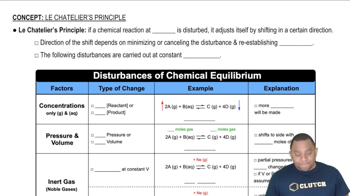
Le Chatelier's Principle

Le Chatelier's Principle states that if a dynamic equilibrium is disturbed by changing the conditions, the position of equilibrium shifts to counteract the change. In the context of the given reaction, removing SO₃ will decrease its concentration, prompting the equilibrium to shift to the right to produce more SO₃, thereby restoring balance.
Video consigliato:
Percorso guidato
07:32
Le Chatelier's Principle

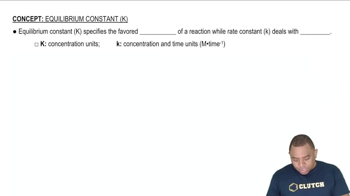
Equilibrium Constant (K)

The equilibrium constant (K) quantifies the ratio of the concentrations of products to reactants at equilibrium for a given reaction at a specific temperature. For the reaction provided, K is determined by the concentrations of SO₃, SO₂, and O₂. Changes in concentration, such as the removal of SO₃, can affect the system's ability to reach a new equilibrium state.
Video consigliato:
Percorso guidato
01:14
Equilibrium Constant K

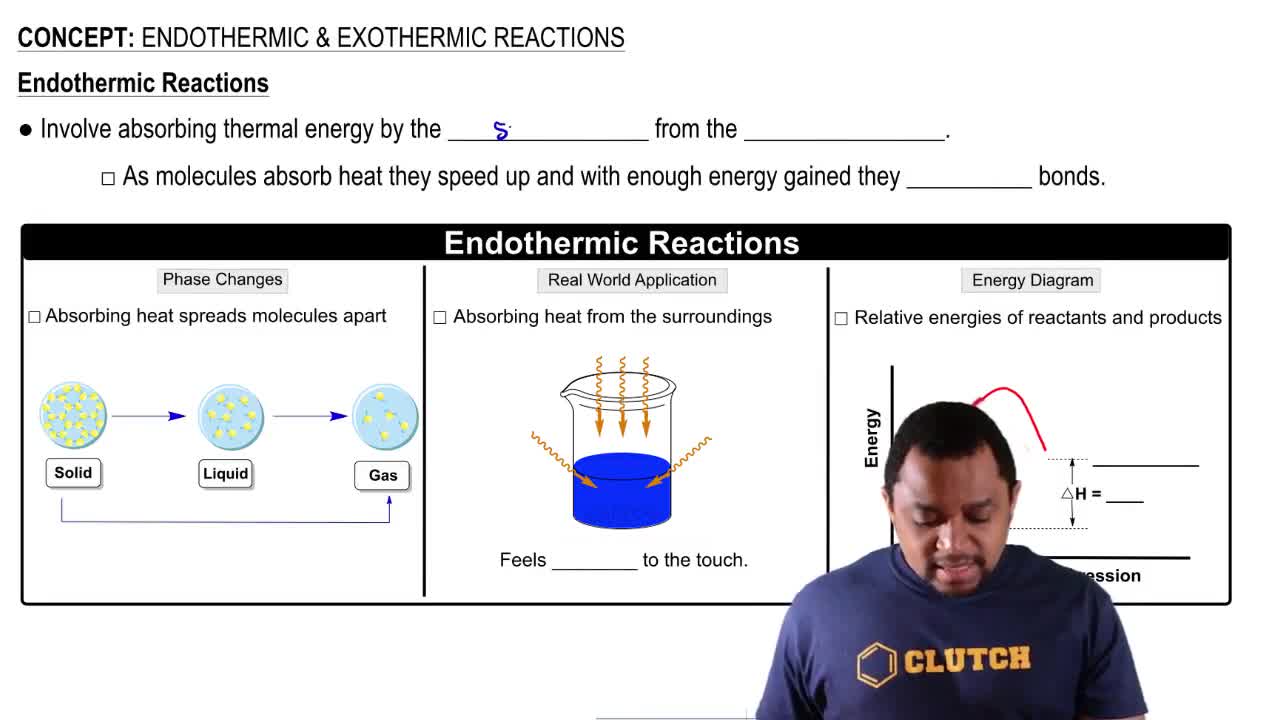
Endothermic vs. Exothermic Reactions

Reactions are classified as endothermic or exothermic based on the heat exchange with the surroundings. The given reaction is exothermic (ΔH < 0), meaning it releases heat. Understanding this helps predict how temperature changes might affect the equilibrium; for instance, removing a product like SO₃ can shift the equilibrium to the right, potentially releasing heat and favoring the formation of more products.
Video consigliato:
Percorso guidato
02:30
Endothermic & Exothermic Reactions