Ch.15 - Chemical Equilibrium
Brown - Chemistry: The Central Science 15th Edition
Brown15th EditionChemistry: The Central ScienceISBN: 9780137542970Non è quello che usi tu?Cambia libro di testo
Capitolo 15, Problema 41b

Indicate whether each of the following statements about the reaction quotient Q is true or false: (b) If 𝑄𝑐 < 𝐾𝑐, the reaction needs to proceed to the right to reach equilibrium.

Guida verificata passo dopo passo
1
Identify the relationship between the reaction quotient \( Q_c \) and the equilibrium constant \( K_c \).
Understand that \( Q_c \) is calculated using the concentrations of the reactants and products at any point in time, while \( K_c \) is calculated using concentrations at equilibrium.
Recognize that if \( Q_c < K_c \), it indicates that the concentration of products is less than what is required at equilibrium.
Conclude that the reaction will proceed in the forward direction (to the right) to increase the concentration of products and decrease the concentration of reactants until \( Q_c = K_c \).
Therefore, the statement is true: If \( Q_c < K_c \), the reaction needs to proceed to the right to reach equilibrium.

Risposta video verificata per un problema simile:

Questa soluzione video è stata consigliata dai nostri tutor come utile per risolvere questo problema.
Durata del video:
1m

Concetti chiave

Ecco i concetti essenziali che devi comprendere per rispondere correttamente alla domanda.

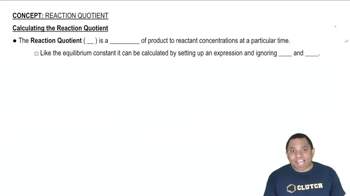
Reaction Quotient (Q)

The reaction quotient, Q, is a measure of the relative concentrations of products and reactants at any point in a reaction. It is calculated using the same expression as the equilibrium constant (K), but with the current concentrations instead of equilibrium concentrations. Q helps determine the direction in which a reaction will proceed to reach equilibrium.
Video consigliato:
Percorso guidato
00:49
Reaction Quotient Q

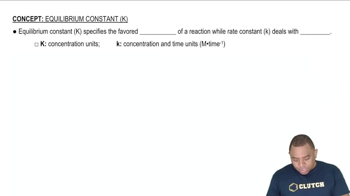
Equilibrium Constant (K)

The equilibrium constant, K, is a value that expresses the ratio of the concentrations of products to reactants at equilibrium for a given reaction at a specific temperature. If K is greater than 1, products are favored at equilibrium; if K is less than 1, reactants are favored. K is a crucial reference point for comparing with Q to predict the direction of the reaction.
Video consigliato:
Percorso guidato
01:14
Equilibrium Constant K

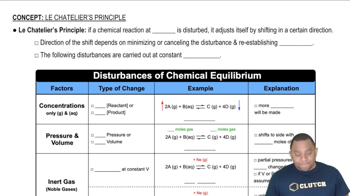
Le Chatelier's Principle

Le Chatelier's Principle states that if a system at equilibrium is disturbed, the system will adjust to counteract the disturbance and restore a new equilibrium. This principle helps explain how changes in concentration, pressure, or temperature affect the position of equilibrium, guiding predictions about whether a reaction will shift to the right (toward products) or left (toward reactants).
Video consigliato:
Percorso guidato
07:32
Le Chatelier's Principle