
Ch.15 - Chemical Equilibrium
Brown - Chemistry: The Central Science 15th Edition
Brown15th EditionChemistry: The Central ScienceISBN: 9780137542970Non è quello che usi tu?Cambia libro di testo
Capitolo 15, Problema 84b

Nitric oxide (NO) reacts readily with chlorine gas as follows: 2 NO(𝑔) + Cl2(𝑔) ⇌ 2 NOCl(𝑔) At 700 K, the equilibrium constant 𝐾𝑝 for this reaction is 0.26. For each of the following mixtures at this temperature, indicate whether the mixture is at equilibrium, or, if not, whether it needs to produce more products or reactants to reach equilibrium. (b) 𝑃NO = 0.12atm, 𝑃Cl2 = 0.10atm, 𝑃NOCl = 0.050atm

Guida verificata passo dopo passo
1
Calculate the reaction quotient, Qp, using the formula: Qp = (P_NOCl)^2 / (P_NO)^2 * (P_Cl2).
Substitute the given partial pressures into the Qp expression: P_NO = 0.12 atm, P_Cl2 = 0.10 atm, P_NOCl = 0.050 atm.
Compare the calculated Qp value with the given equilibrium constant Kp = 0.26.
If Qp = Kp, the system is at equilibrium. If Qp < Kp, the reaction will proceed in the forward direction to produce more products. If Qp > Kp, the reaction will proceed in the reverse direction to produce more reactants.
Based on the comparison, determine whether the mixture is at equilibrium or if it needs to shift to reach equilibrium.

Risposta video verificata per un problema simile:

Questa soluzione video è stata consigliata dai nostri tutor come utile per risolvere questo problema.
Durata del video:
5m

Concetti chiave

Ecco i concetti essenziali che devi comprendere per rispondere correttamente alla domanda.

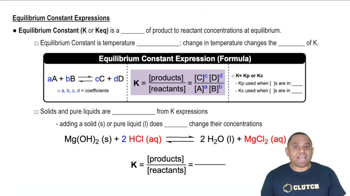
Equilibrium Constant (Kp)

The equilibrium constant, Kp, quantifies the ratio of the partial pressures of products to reactants at equilibrium for a given reaction. For the reaction 2 NO(g) + Cl2(g) ⇌ 2 NOCl(g), Kp is calculated as (P_NOCl^2) / (P_NO^2 * P_Cl2). A Kp value of 0.26 indicates that at equilibrium, the concentration of products is relatively low compared to reactants, guiding predictions about the direction of the reaction.
Video consigliato:
Percorso guidato
03:20
Equilibrium Constant Expressions

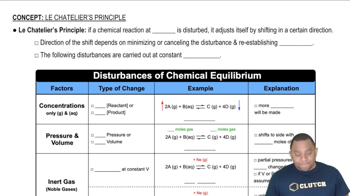
Le Chatelier's Principle

Le Chatelier's Principle states that if a system at equilibrium is disturbed by changes in concentration, pressure, or temperature, the system will adjust to counteract the disturbance and restore a new equilibrium. In this context, if the partial pressures of NO, Cl2, or NOCl are altered, the reaction will shift towards the side that reduces the effect of the change, either producing more products or reactants.
Video consigliato:
Percorso guidato
07:32
Le Chatelier's Principle

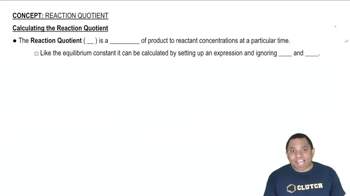
Reaction Quotient (Q)

The reaction quotient, Q, is calculated using the same formula as Kp but with the current partial pressures of the reactants and products. By comparing Q to Kp, one can determine the direction in which the reaction will proceed to reach equilibrium. If Q < Kp, the reaction will shift to the right (producing more products), while if Q > Kp, it will shift to the left (producing more reactants).
Video consigliato:
Percorso guidato
00:49
Reaction Quotient Q
Pratica correlata
Domanda del libro di testo

A 0.831-g sample of SO3 is placed in a 1.00-L container and heated to 1100 K. The SO3 decomposes to SO2 and O2: 2SO3(𝑔) ⇌ 2 SO2(𝑔) + O2(𝑔) At equilibrium, the total pressure in the container is 1.300 atm. Find the values of 𝐾𝑝 and 𝐾𝑐 for this reaction at 1100 K.

1351
views
Domanda del libro di testo

For the equilibrium PH3BCl3(𝑠) ⇌ PH3(𝑔) + BCl3(𝑔) 𝐾𝑝 = 0.052 at 60°C. (b) A closed 1.500-L vessel at 60°C is charged with 0.0500 g of BCl3(𝑔); 3.00 g of solid PH3BCl3 is then added to the flask, and the system is allowed to equilibrate. What is the equilibrium concentration of PH3?

Domanda del libro di testo

The equilibrium constant constant 𝐾𝑐 for C(𝑠) + CO2(𝑔) ⇌ 2 CO(𝑔) is 1.9 at 1000 K and 0.133 at 298 K. (a) If excess C is allowed to react with 25.0 g of CO2 in a 3.00-L vessel at 1000 K, how many grams of CO are produced? (b) If excess C is allowed to react with 25.0 g of CO2 in a 3.00-L vessel at 1000 K, how many grams of C are consumed?

954
views
Domanda del libro di testo

At 900 °C, 𝐾𝑐 = 0.0108 for the reaction

CaCO3(𝑠) ⇌ CaO(𝑠) + CO2(𝑔)

A mixture of CaCO3, CaO, and CO2 is placed in a 10.0-L vessel at 900°C. For the following mixtures, will the amount of CaCO3 increase, decrease, or remain the same as the system approaches equilibrium?

(a) 15.0 g CaCO3, 15.0 g CaO, and 4.25 g CO2

(b) 2.50 g CaCO3, 25.0 g CaO, and 5.66 g CO2

(c) 30.5 g CaCO3, 25.5 g CaO, and 6.48 g CO2

724
views
1
rank