Ch.15 - Chemical Equilibrium
Brown - Chemistry: The Central Science 15th Edition
Brown15th EditionChemistry: The Central ScienceISBN: 9780137542970Non è quello che usi tu?Cambia libro di testo
Capitolo 15, Problema 15e

Write the expression for Kc for the following reactions. In each case indicate whether the reaction is homogeneous or heterogeneous.
(a) 3 NO(g) ⇌ N2O(g) + NO2(g)
(b) CH4(g) + 2 H2S(g) ⇌ CS2(g) + 4 H2(g)
(c) Ni(CO)4(g) ⇌ Ni(s) + 4 CO(g)
(d) HF(aq) ⇌ H+(aq) + F-(aq)  
(e) 2Ag(s) + Zn2+(aq) ⇌ 2 Ag+(aq) + Zn(s)
(f) H2O(l) ⇌ H+(aq) + OH-(aq)
(g) 2 H2O(l) ⇌ 2 H+(aq) + 2 OH-(aq)

Guida verificata passo dopo passo
1
Identify the reactants and products in the reaction. For the given reaction, the reactants are Ag(s) and Zn2+(aq), and the products are Ag+(aq) and Zn(s).
Write the expression for the equilibrium constant, Kc, using the concentrations of the aqueous species. For each species, raise the concentration to the power of its stoichiometric coefficient in the balanced equation.
Since Ag(s) and Zn(s) are solids, their activity is considered to be 1 and they do not appear in the expression for Kc.
The expression for Kc is therefore: Kc = [Ag+]^2 / [Zn2+]
Determine the type of reaction: Since the reaction involves both solid and aqueous species, it is a heterogeneous reaction.

Risposta video verificata per un problema simile:

Questa soluzione video è stata consigliata dai nostri tutor come utile per risolvere questo problema.
Durata del video:
2m

Concetti chiave

Ecco i concetti essenziali che devi comprendere per rispondere correttamente alla domanda.

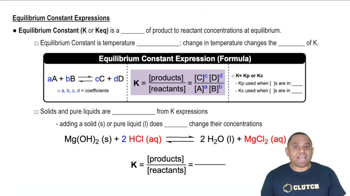
Equilibrium Constant (Kc)

The equilibrium constant, Kc, is a numerical value that expresses the ratio of the concentrations of products to the concentrations of reactants at equilibrium for a given reaction at a specific temperature. It is calculated using the formula Kc = [products]^[coefficients] / [reactants]^[coefficients]. Understanding Kc is essential for predicting the direction of a reaction and the extent to which reactants are converted to products.
Video consigliato:
Percorso guidato
03:20
Equilibrium Constant Expressions

Homogeneous vs. Heterogeneous Reactions

Homogeneous reactions occur when all reactants and products are in the same phase (solid, liquid, or gas), while heterogeneous reactions involve reactants and products in different phases. This distinction is important because it affects how concentrations are expressed in the Kc expression. In heterogeneous reactions, only the concentrations of species in the aqueous or gaseous phase are included in the Kc expression, while solids and liquids are omitted.
Video consigliato:
Percorso guidato
03:05
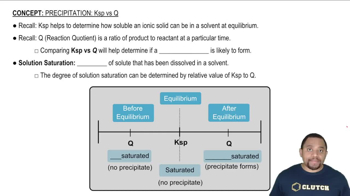
Ksp vs Q in Precipitation

Phase Representation in Reactions

In chemical equations, the physical state of each substance is indicated by symbols: (s) for solid, (l) for liquid, (g) for gas, and (aq) for aqueous solutions. This representation is crucial for determining the correct form of the Kc expression. For example, in the given reaction, only the aqueous ions are included in the Kc expression, as the solid metals do not contribute to the equilibrium concentrations.
Video consigliato:
Percorso guidato
03:22
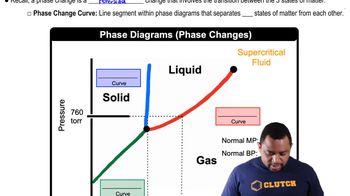
Phase Changes in Diagrams
Pratica correlata
Domanda del libro di testo

The equilibrium constant for the dissociation of molecular iodine, I2(g) ⇌ 2 I(g), at 800 K is Kc = 3.1 × 10⁻⁵. (a) Which species predominates at equilibrium I2 or I?

Domanda del libro di testo

Write the expressions for 𝐾𝑐 for the following reactions. In each case indicate whether the reaction is homogeneous or heterogeneous.

(b) Ti(𝑠) + 2Cl2(𝑔) ⇌ TiCl4(𝑙)

460
views
Domanda del libro di testo

The equilibrium constant for the dissociation of molecular iodine, I2(g) ⇌ 2 I(g), at 800 K is Kc = 3.1×10⁻⁵. (b) Assuming both forward and reverse reactions are elementary reactions, which reaction has the larger rate constant, the forward or the reverse reaction?

1209
views
Domanda del libro di testo

Write the expressions for Kc for the following reactions. In each case indicate whether the reaction is homogeneous or heterogeneous.

(a) 2 O3(g) ⇌ 3 O2(g)

(c) 2 C2H4(g) + 2 H2O(g) ⇌ 2 C2H6(g) + O2(g)

(d) C(s) + 2 H2(g) ⇌ CH4(g)

(e) 4 HCl(aq) + O2(g) ⇌ 2 H2O(l) + 2 Cl2(g)

(f) 2 C8H18(l) + 25 O2(g) ⇌ 16 CO2(g) + 18 H2O(g)

(g) 2 C8H18(l) + 25 O2(g) ⇌ 16 CO2(g) + 18 H2O(l)

487
views
Domanda del libro di testo

Suppose that the gas-phase reactions A → B and B → A are both elementary reactions with rate constants of 4.7×10⁻³ s−1 and 5.8×10⁻¹ s−1, respectively. (a) What is the value of the equilibrium constant for the equilibrium A(g) ⇌ B(g)? (b) Which is greater at equilibrium, the partial pressure of A or the partial pressure of B?

469
views