
Ch.16 - Acid-Base Equilibria
Brown - Chemistry: The Central Science 15th Edition
Brown15th EditionChemistry: The Central ScienceISBN: 9780137542970Non è quello che usi tu?Cambia libro di testo
Capitolo 16, Problema 117a

Atmospheric CO2 levels have risen by nearly 20% over the past 40 years from 320 ppm to 400 ppm. (a) Given that the average pH of clean, unpolluted rain today is 5.4, determine the pH of unpolluted rain 40 years ago. Assume that carbonic acid 1H2CO32 formed by the reaction of CO2 and water is the only factor influencing pH. CO21g2 + H2O1l2 Δ H2CO31aq2

Guida verificata passo dopo passo
1
Identify the chemical reaction involved: CO_2(g) + H_2O(l) \(\rightleftharpoons\) H_2CO_3(aq).
Understand that the pH of rainwater is influenced by the concentration of carbonic acid (H_2CO_3), which is formed from CO_2 and water.
Use the given information that the pH of rainwater today is 5.4, which corresponds to a certain concentration of H^+ ions.
Recognize that 40 years ago, the concentration of CO_2 was 320 ppm, compared to 400 ppm today, indicating a lower concentration of carbonic acid and thus a higher pH.
Calculate the pH 40 years ago by determining the concentration of H^+ ions from the lower concentration of carbonic acid, using the relationship between pH and H^+ concentration: pH = -\(\log\)[H^+].

Risposta video verificata per un problema simile:

Questa soluzione video è stata consigliata dai nostri tutor come utile per risolvere questo problema.
Durata del video:
13m

Concetti chiave

Ecco i concetti essenziali che devi comprendere per rispondere correttamente alla domanda.

pH Scale

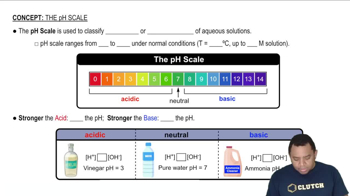
The pH scale measures the acidity or basicity of a solution, ranging from 0 to 14. A pH of 7 is neutral, while values below 7 indicate acidity and above 7 indicate basicity. Each unit change in pH represents a tenfold change in hydrogen ion concentration, making it crucial for understanding how changes in CO2 levels can affect rainwater acidity.
Video consigliato:

Carbonic Acid Formation

Carbonic acid (H2CO3) is formed when carbon dioxide (CO2) dissolves in water, following the reaction CO2 + H2O ⇌ H2CO3. This weak acid dissociates in water, contributing to the acidity of rainwater. Understanding this reaction is essential for determining how increased atmospheric CO2 levels influence the pH of rain.
Video consigliato:
Percorso guidato
01:41
Amide Formation

Acid-Base Equilibrium

Acid-base equilibrium refers to the balance between acids and bases in a solution, which affects pH. In the context of rainwater, the equilibrium between carbonic acid and its dissociated ions (H+ and HCO3-) is influenced by the concentration of CO2. An increase in CO2 leads to more carbonic acid, thus lowering the pH and increasing acidity.
Video consigliato:
Percorso guidato
6:47
Triprotic Acid Equilibrium