
Ch.16 - Acid-Base Equilibria
Brown - Chemistry: The Central Science 15th Edition
Brown15th EditionChemistry: The Central ScienceISBN: 9780137542970Non è quello che usi tu?Cambia libro di testo
Capitolo 16, Problema 84b

Using data from Appendix D, calculate 3OH-4 and pH for each of the following solutions: (b) 0.035 M Na2S

Guida verificata passo dopo passo
1
Identify the relevant chemical species in the solution. Sodium sulfide (Na2S) dissociates in water to form 2 Na^+ ions and 1 S^2- ion.
Recognize that the sulfide ion (S^2-) can react with water in a hydrolysis reaction to form hydroxide ions (OH^-). The reaction is: S^{2-} + H_2O \(\rightleftharpoons\) HS^- + OH^-.
Write the equilibrium expression for the hydrolysis reaction. The equilibrium constant for this reaction is the base dissociation constant, K_b, which can be found using the relationship K_w = K_a \(\times\) K_b, where K_w is the ion-product constant of water and K_a is the acid dissociation constant for the conjugate acid (HS^-).
Calculate the concentration of OH^- ions produced by the hydrolysis of S^2-. Use the initial concentration of S^2- (0.035 M) and the equilibrium expression to solve for [OH^-].
Determine the pH of the solution. First, calculate the pOH using the concentration of OH^- ions: \(\text{pOH}\) = -\(\log\)[OH^-]. Then, use the relationship \(\text{pH}\) + \(\text{pOH}\) = 14 to find the pH.

Risposta video verificata per un problema simile:

Questa soluzione video è stata consigliata dai nostri tutor come utile per risolvere questo problema.
Durata del video:
4m

Concetti chiave

Ecco i concetti essenziali che devi comprendere per rispondere correttamente alla domanda.

Dissociation of Sodium Sulfide (Na2S)

Sodium sulfide (Na2S) dissociates in water to produce sodium ions (Na+) and sulfide ions (S2-). The sulfide ion can further react with water to form hydroxide ions (OH-) and hydrogen sulfide (H2S), leading to an increase in the concentration of OH- in the solution. Understanding this dissociation is crucial for calculating the concentration of hydroxide ions in the solution.
Video consigliato:
Percorso guidato
04:52
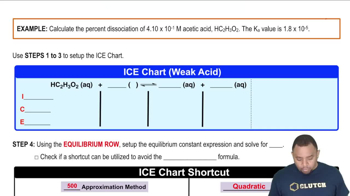
Percent Dissociation Example

Hydroxide Ion Concentration (OH-)

The concentration of hydroxide ions (OH-) is a key factor in determining the basicity of a solution. In this case, the dissociation of Na2S produces OH- ions, which can be calculated based on the stoichiometry of the reaction. The concentration of OH- is essential for calculating the pH of the solution, as it directly influences the acidity or basicity.
Video consigliato:
Percorso guidato
06:12
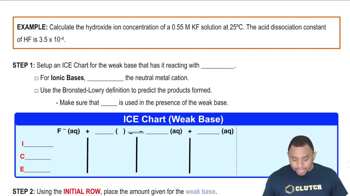
Hydroxide Ion Concentration Example

pH Calculation

pH is a measure of the acidity or basicity of a solution, defined as the negative logarithm of the hydrogen ion concentration (H+). For basic solutions, pH can be calculated using the relationship between pH and pOH, where pH + pOH = 14. By first determining the concentration of OH- from the dissociation of Na2S, one can find pOH and subsequently calculate the pH of the solution.
Video consigliato:
Percorso guidato
02:15
pH Calculation Example