Ch.17 - Additional Aspects of Aqueous Equilibria
Brown - Chemistry: The Central Science 15th Edition
Brown15th EditionChemistry: The Central ScienceISBN: 9780137542970Non è quello che usi tu?Cambia libro di testo
Capitolo 17, Problema 43c

A 20.0-mL sample of 0.200 M HBr solution is titrated with 0.200 M NaOH solution. Calculate the pH of the solution after the following volumes of base have been added:
(c) 20.0 mL.

Guida verificata passo dopo passo
1
Step 1: Identify the type of reaction occurring. This is a neutralization reaction between a strong acid (HBr) and a strong base (NaOH). The reaction can be represented as: \[ \text{HBr} + \text{NaOH} \rightarrow \text{NaBr} + \text{H}_2\text{O} \]
Step 2: Calculate the moles of HBr initially present in the solution. Use the formula: \[ \text{moles of HBr} = \text{volume (L)} \times \text{molarity (M)} \]. For 20.0 mL of 0.200 M HBr, convert the volume to liters and calculate the moles.
Step 3: Calculate the moles of NaOH added. Similarly, use the formula: \[ \text{moles of NaOH} = \text{volume (L)} \times \text{molarity (M)} \]. For 20.0 mL of 0.200 M NaOH, convert the volume to liters and calculate the moles.
Step 4: Determine the limiting reactant. Since both HBr and NaOH have the same concentration and volume, they will react in a 1:1 ratio, and both will be completely consumed in the reaction.
Step 5: Calculate the pH of the resulting solution. After complete neutralization, the solution contains only water and the salt NaBr, which does not affect the pH. Therefore, the pH of the solution is neutral, which is 7.

Risposta video verificata per un problema simile:

Questa soluzione video è stata consigliata dai nostri tutor come utile per risolvere questo problema.
Durata del video:
5m

Concetti chiave

Ecco i concetti essenziali che devi comprendere per rispondere correttamente alla domanda.

Titration

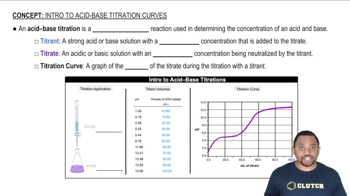
Titration is a quantitative analytical technique used to determine the concentration of a solute in a solution. It involves the gradual addition of a titrant (in this case, NaOH) to a solution containing the analyte (HBr) until the reaction reaches its equivalence point, where the amount of titrant added is stoichiometrically equivalent to the amount of analyte present.
Video consigliato:
Percorso guidato
03:04
Acid-Base Titration

pH and Neutralization

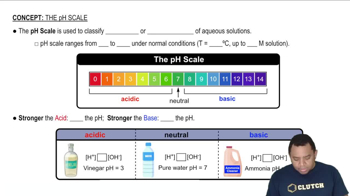
pH is a measure of the acidity or basicity of a solution, defined as the negative logarithm of the hydrogen ion concentration. In a neutralization reaction between a strong acid (HBr) and a strong base (NaOH), the pH at the equivalence point is typically 7, indicating a neutral solution. Understanding how to calculate pH before and after the equivalence point is crucial for solving titration problems.
Video consigliato:

Stoichiometry of Acid-Base Reactions

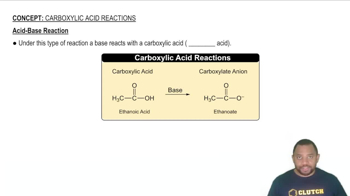
Stoichiometry involves the calculation of reactants and products in chemical reactions based on balanced equations. For the reaction between HBr and NaOH, the balanced equation shows a 1:1 molar ratio. This means that equal moles of HBr and NaOH will neutralize each other, allowing for the calculation of remaining concentrations and pH after specific volumes of base are added.
Video consigliato:
Percorso guidato
01:09
Acid-Base Reaction