
Ch.17 - Additional Aspects of Aqueous Equilibria
Brown - Chemistry: The Central Science 15th Edition
Brown15th EditionChemistry: The Central ScienceISBN: 9780137542970Non è quello che usi tu?Cambia libro di testo
Capitolo 17, Problema 36b

Determine whether each of the following statements concerning the titrations in Problem 17.35 is true or false. b. Both titration curves will be essentially the same after passing the equivalence point.

Guida verificata passo dopo passo
1
insert step 1> Identify the type of titration being discussed in Problem 17.35. This could be a strong acid-strong base, strong acid-weak base, weak acid-strong base, or weak acid-weak base titration.
insert step 2> Understand that after the equivalence point in a titration, the pH is determined by the excess titrant.
insert step 3> Consider the nature of the titrant added after the equivalence point. For example, if a strong base is added, the pH will be high, and if a strong acid is added, the pH will be low.
insert step 4> Analyze whether the titrations in Problem 17.35 involve the same titrant after the equivalence point. If they do, the pH behavior will be similar.
insert step 5> Conclude whether the statement is true or false based on whether the titrations involve the same titrant and thus have similar pH behavior after the equivalence point.

Risposta video verificata per un problema simile:

Questa soluzione video è stata consigliata dai nostri tutor come utile per risolvere questo problema.
Durata del video:
1m

Concetti chiave

Ecco i concetti essenziali che devi comprendere per rispondere correttamente alla domanda.

Titration Curves

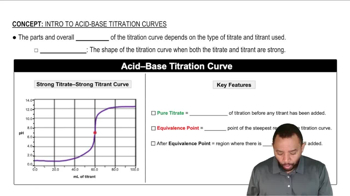
Titration curves graphically represent the pH of a solution as a function of the volume of titrant added. They typically show a gradual change in pH, followed by a steep rise near the equivalence point, where the amount of titrant is stoichiometrically equivalent to the amount of analyte. Understanding these curves is essential for analyzing the behavior of acids and bases during titration.
Video consigliato:
Percorso guidato
02:16
Acid-Base Titration Curves

Equivalence Point

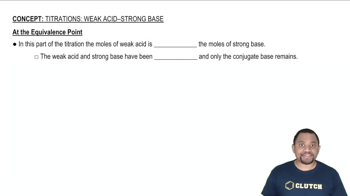
The equivalence point in a titration is the stage at which the amount of titrant added is exactly enough to completely neutralize the analyte in the solution. At this point, the moles of acid equal the moles of base, resulting in a significant change in pH. Recognizing the equivalence point is crucial for interpreting titration curves and determining the concentration of unknown solutions.
Video consigliato:
Percorso guidato
01:07
At the Equivalence Point

Acid-Base Properties

Acid-base properties refer to the characteristics of substances that determine their behavior in reactions involving protons (H+ ions). Strong acids and bases dissociate completely in solution, while weak acids and bases do not. The nature of the acid and base involved in the titration affects the shape of the titration curve, particularly after the equivalence point, influencing whether the curves will be similar or different.
Video consigliato:
Percorso guidato
02:00
Arrhenius Acids and Bases