
Ch.17 - Additional Aspects of Aqueous Equilibria
Brown - Chemistry: The Central Science 15th Edition
Brown15th EditionChemistry: The Central ScienceISBN: 9780137542970Non è quello che usi tu?Cambia libro di testo
Capitolo 17, Problema 113

Excess Ca(OH)₂ is shaken with water to produce a saturated solution. The solution is filtered, and a 50.00-mL sample is titrated with HCl, requiring 11.23 mL of 0.0983 M HCl to reach the endpoint. Calculate Ksp for Ca(OH)₂. Compare your result with that in Appendix D. Suggest a reason for any differences you find between your value and the one in Appendix D.

Guida verificata passo dopo passo
1
Step 1: Write the balanced chemical equation for the dissolution of Ca(OH)_2 in water: Ca(OH)_2 (s) ⇌ Ca^{2+} (aq) + 2OH^{-} (aq).
Step 2: Determine the moles of HCl used in the titration. Use the formula: \( \text{moles of HCl} = M \times V \), where \( M \) is the molarity and \( V \) is the volume in liters.
Step 3: Since HCl reacts with OH^- in a 1:1 ratio, the moles of OH^- in the solution are equal to the moles of HCl used.
Step 4: Calculate the concentration of OH^- ions in the 50.00 mL sample. Use the formula: \( [OH^-] = \frac{\text{moles of OH^-}}{\text{volume of solution in liters}} \).
Step 5: Use the concentration of OH^- to find the concentration of Ca^{2+} ions. Since the stoichiometry of the dissolution is 1:2, \( [Ca^{2+}] = \frac{1}{2} [OH^-] \). Then, calculate the K_{sp} using the expression: \( K_{sp} = [Ca^{2+}][OH^-]^2 \).

Concetti chiave

Ecco i concetti essenziali che devi comprendere per rispondere correttamente alla domanda.

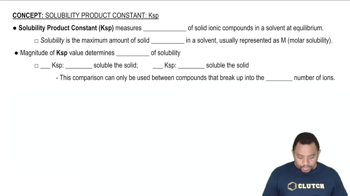
Solubility Product Constant (Ksp)

The solubility product constant (Ksp) is an equilibrium constant that quantifies the solubility of a sparingly soluble ionic compound. It is defined as the product of the molar concentrations of the ions, each raised to the power of their coefficients in the balanced dissolution equation. For calcium hydroxide, Ca(OH)₂, the dissolution can be represented as Ca(OH)₂(s) ⇌ Ca²⁺(aq) + 2OH⁻(aq), leading to the expression Ksp = [Ca²⁺][OH⁻]².
Video consigliato:
Percorso guidato
01:47
Solubility Product Constant

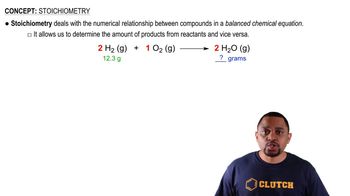
Titration and Stoichiometry

Titration is a quantitative analytical technique used to determine the concentration of a solute in a solution. In this case, hydrochloric acid (HCl) is used to titrate the hydroxide ions (OH⁻) from the saturated calcium hydroxide solution. The stoichiometry of the reaction, which is 1:1 for HCl and OH⁻, allows for the calculation of the moles of OH⁻ present, which is essential for determining the Ksp value.
Video consigliato:
Percorso guidato
01:16
Stoichiometry Concept

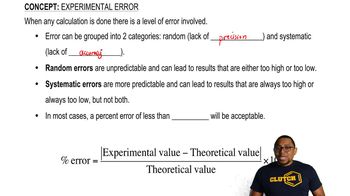
Comparison of Experimental and Literature Values

When comparing the experimentally determined Ksp value with literature values, discrepancies may arise due to factors such as temperature differences, impurities in the reagents, or measurement errors. The Ksp value is temperature-dependent, and variations in experimental conditions can lead to different solubility outcomes. Understanding these factors is crucial for interpreting results and assessing the reliability of experimental data.
Video consigliato:
Percorso guidato
05:50
Experimental Error
Pratica correlata
Domanda del libro di testo

A concentration of 10–100 parts per billion (by mass) of Ag+ is an effective disinfectant in swimming pools. However, if the concentration exceeds this range, the Ag+ can cause adverse health effects. One way to maintain an appropriate concentration of Ag+ is to add a slightly soluble salt to the pool. Using Ksp values from Appendix D, calculate the equilibrium concentration of Ag+ in parts per billion that would exist in equilibrium with (b) AgBr (c) AgI.

986
views
Domanda del libro di testo

(a) Write the net ionic equation for the reaction that occurs when a solution of hydrochloric acid (HCl) is mixed with a solution of sodium formate 1NaCHO22.

1573
views
Domanda del libro di testo

Fluoridation of drinking water is employed in many places to aid in the prevention of tooth decay. Typically. the Fion concentration is adjusted to about 1 ppm. Some water supplies are also 'hard'; that is, they contain certain cations such as Ca2 + that interfere with the action of soap. Consider a case where the concentration of Ca2 + is 8 ppm. Could a precipitate of CaF2 form under these conditions? (Make any necessary approximations.)

372
views
Domanda del libro di testo

What is the pH at 25 C of water saturated with CO2 at a partial pressure of 1.10 atm? The Henry's law constant for CO2 at 25 C is 3.1 * 10-2 mol>L@atm.

840
views
Domanda del libro di testo

The osmotic pressure of a saturated solution of strontium sulfate at 25 C is 21 torr. What is the solubility product of this salt at 25 C?

809
views