Ch.17 - Additional Aspects of Aqueous Equilibria
Brown - Chemistry: The Central Science 15th Edition
Brown15th EditionChemistry: The Central ScienceISBN: 9780137542970Non è quello che usi tu?Cambia libro di testo
Capitolo 17, Problema 4a

The following diagram represents a buffer composed of equal concentrations of a weak acid, HA, and its conjugate base, A-. The heights of the columns are proportional to the concentrations of the components of the buffer. (a) Which of the three drawings, (1), (2), or (3), represents the buffer after the addition of a strong acid? [Section 17.2]

Guida verificata passo dopo passo
1
Identify the components of the buffer: a weak acid (HA) and its conjugate base (A-).
Understand that adding a strong acid to the buffer will increase the concentration of H+ ions.
Recognize that the added H+ ions will react with the conjugate base (A-) to form more of the weak acid (HA).
Determine that the concentration of the conjugate base (A-) will decrease, while the concentration of the weak acid (HA) will increase.
Look for the drawing where the column representing HA is taller and the column representing A- is shorter compared to the original buffer.

Risposta video verificata per un problema simile:

Questa soluzione video è stata consigliata dai nostri tutor come utile per risolvere questo problema.
Durata del video:
5m

Concetti chiave

Ecco i concetti essenziali che devi comprendere per rispondere correttamente alla domanda.

Buffer Solutions

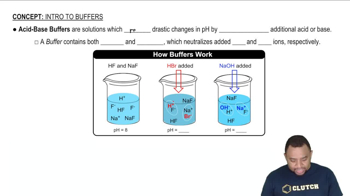
A buffer solution is a system that resists changes in pH upon the addition of small amounts of acid or base. It typically consists of a weak acid and its conjugate base in equilibrium. This equilibrium allows the buffer to neutralize added acids or bases, maintaining a relatively stable pH.
Video consigliato:
Percorso guidato
03:02
Buffer Solutions

Weak Acids and Conjugate Bases

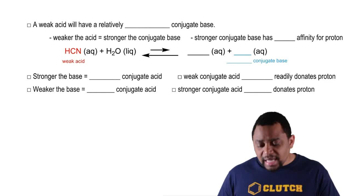
Weak acids partially dissociate in solution, establishing an equilibrium between the undissociated acid (HA) and its ions (H+ and A-). The conjugate base (A-) can react with added H+ ions from a strong acid, minimizing the change in pH. Understanding this equilibrium is crucial for predicting how a buffer will respond to external changes.
Video consigliato:
Percorso guidato
01:46
Conjugate Acid-Base Relationships

Effect of Strong Acid on Buffer

When a strong acid is added to a buffer solution, it increases the concentration of H+ ions. The weak acid component of the buffer will react with these H+ ions, shifting the equilibrium and converting some of the conjugate base (A-) into more weak acid (HA). This process helps to mitigate the pH change, but the buffer's capacity is limited and can be overwhelmed if too much strong acid is added.
Video consigliato:
Percorso guidato
01:14
Effective Buffer Range
Pratica correlata
Domanda del libro di testo

Match the following descriptions of titration curves with the diagrams: (a) strong acid added to strong base. [Section 17.3]

544
views

Domanda del libro di testo

The following diagram represents a buffer composed of equal concentrations of a weak acid, HA, and its conjugate base, A-. The heights of the columns are proportional to the concentrations of the components of the buffer. (c) Which of the three represents a situation that cannot arise from the addition of either an acid or a base? [Section 17.2]

694
views
Domanda del libro di testo

The following figure represents solutions at various stages of the titration of a weak acid, HA, with NaOH. (The Na+ ions and water molecules have been omitted for clarity.) To which of the following regions of the titration curve does each drawing correspond: (b) after addition of NaOH but before the equivalence point? [Section 17.3]

1274
views
Domanda del libro di testo

The beaker on the right contains 0.1 M acetic acid solution with methyl orange as an indicator. The beaker on the left contains a mixture of 0.1 M acetic acid and 0.1 M sodium acetate with methyl orange. (a) Using Figures 16.8 and 16.9, which solution has a higher pH?

747
views
Domanda del libro di testo

The beaker on the right contains 0.1 M acetic acid solution with methyl orange as an indicator. The beaker on the left contains a mixture of 0.1 M acetic acid and 0.1 M sodium acetate with methyl orange. (b) Which solution is better able to maintain its pH when small amounts of NaOH are added? Explain. [Sections 17.1 and 17.2]

642
views
Domanda del libro di testo

A buffer contains a weak acid, HA, and its conjugate base. The weak acid has a pKa of 4.5, and the buffer has a pH of 4.3. Without doing a calculation, state which of these possibilities are correct at pH 4.3. (a) 3HA4 = 3A-4, (b) 3HA4 7 3A-4, or (c) 3HA4 6 3A-4. [Section 17.2]

2792
views
1
rank