
Ch.17 - Additional Aspects of Aqueous Equilibria
Brown - Chemistry: The Central Science 15th Edition
Brown15th EditionChemistry: The Central ScienceISBN: 9780137542970Non è quello che usi tu?Cambia libro di testo
Capitolo 17, Problema 99b

The solubility of CaCO3 is pH dependent. (b) Use the Kb expression for the CO32- ion to determine the equilibrium constant for the reaction CaCO3(s) + H2O(l) ⇌ Ca2+(aq) + HCO3-(aq) + OH-(aq)

Guida verificata passo dopo passo
1
Write the balanced chemical equation for the dissolution of CaCO3 in water: CaCO3(s) + H2O(l) ⇌ Ca^2+(aq) + HCO3^-(aq) + OH^-(aq).
Identify the Kb expression for the CO3^2- ion, which is the base dissociation constant for the reaction CO3^2-(aq) + H2O(l) ⇌ HCO3^-(aq) + OH^-(aq).
Use the Kb expression to express the concentrations of the products and reactants at equilibrium. The expression is Kb = [HCO3^-][OH^-] / [CO3^2-].
Combine the dissolution equation of CaCO3 and the Kb expression to find the overall equilibrium expression. Since CaCO3 is a solid, its concentration does not appear in the expression.
Solve for the equilibrium constant (K) of the overall reaction by incorporating the stoichiometry and the constants from the Kb expression. This will involve algebraic manipulation to express K in terms of known quantities and constants.

Risposta video verificata per un problema simile:

Questa soluzione video è stata consigliata dai nostri tutor come utile per risolvere questo problema.
Durata del video:
3m

Concetti chiave

Ecco i concetti essenziali che devi comprendere per rispondere correttamente alla domanda.

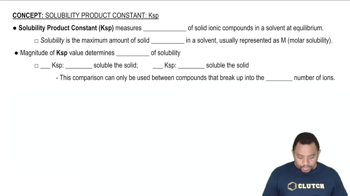
Solubility Product Constant (Ksp)

The solubility product constant (Ksp) is an equilibrium constant that applies to the solubility of sparingly soluble ionic compounds. It represents the product of the molar concentrations of the ions, each raised to the power of their coefficients in the balanced equation. For calcium carbonate (CaCO3), Ksp can be used to understand how its solubility changes with pH, as the formation of bicarbonate and carbonate ions affects the equilibrium.
Video consigliato:
Percorso guidato
01:47
Solubility Product Constant

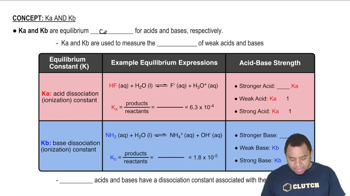
Base Ionization Constant (Kb)

The base ionization constant (Kb) is a measure of the strength of a base in solution, indicating how well it can accept protons (H+) from water. For the carbonate ion (CO32-), Kb can be used to derive the equilibrium constant for its reaction with water, producing bicarbonate (HCO3-) and hydroxide ions (OH-). This relationship is crucial for understanding the pH dependence of CaCO3 solubility.
Video consigliato:
Percorso guidato
03:50
Characteristics of Ka and Kb

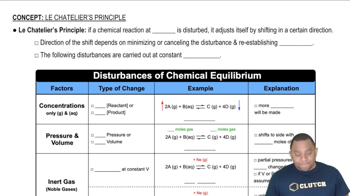
Le Chatelier's Principle

Le Chatelier's Principle states that if a system at equilibrium is subjected to a change in concentration, temperature, or pressure, the system will adjust to counteract that change and restore a new equilibrium. In the context of CaCO3 solubility, changes in pH (which affect the concentration of H+ ions) will shift the equilibrium position, influencing the solubility of CaCO3 and the formation of its ions in solution.
Video consigliato:
Percorso guidato
07:32
Le Chatelier's Principle