
Ch.17 - Additional Aspects of Aqueous Equilibria
Brown - Chemistry: The Central Science 15th Edition
Brown15th EditionChemistry: The Central ScienceISBN: 9780137542970Non è quello che usi tu?Cambia libro di testo
Capitolo 17, Problema 13

Which of these statements about the common-ion effect is most correct? (a) The solubility of a salt MA is decreased in a solution that already contains either M+ or A-. (b) Common ions alter the equilibrium constant for the reaction of an ionic solid with water. (c) The common-ion effect does not apply to unusual ions like SO32 - . (d) The solubility of a salt MA is affected equally by the addition of either A- or a noncommon ion.

Guida verificata passo dopo passo
1
Identify the definition of the common-ion effect: The common-ion effect occurs when the solubility of an ionic compound decreases due to the presence of one of its ions in the solution from another source.
Analyze statement (a): Consider if the presence of either ion M+ or A- from another source in the solution would affect the solubility of the salt MA.
Evaluate statement (b): Determine if the common-ion effect actually changes the equilibrium constant (K) or just shifts the equilibrium position.
Assess statement (c): Reflect on whether the common-ion effect is limited to common ions or if it can also apply to less common ions like SO32-.
Review statement (d): Think about whether the addition of a common ion (A-) and a noncommon ion would have the same effect on the solubility of the salt MA.

Risposta video verificata per un problema simile:

Questa soluzione video è stata consigliata dai nostri tutor come utile per risolvere questo problema.
Durata del video:
2m

Concetti chiave

Ecco i concetti essenziali che devi comprendere per rispondere correttamente alla domanda.

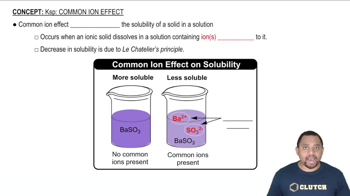
Common-Ion Effect

The common-ion effect refers to the decrease in solubility of a salt when a common ion is added to the solution. This phenomenon occurs because the addition of a common ion shifts the equilibrium of the dissolution reaction, according to Le Chatelier's principle, favoring the formation of the solid salt and reducing the concentration of dissolved ions.
Video consigliato:
Percorso guidato
02:53
Common Ion Effect

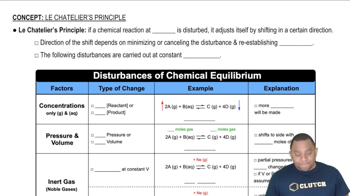
Le Chatelier's Principle

Le Chatelier's principle states that if a dynamic equilibrium is disturbed by changing the conditions, the system will adjust to counteract the change and restore a new equilibrium. In the context of the common-ion effect, adding a common ion shifts the equilibrium position, leading to decreased solubility of the salt.
Video consigliato:
Percorso guidato
07:32
Le Chatelier's Principle

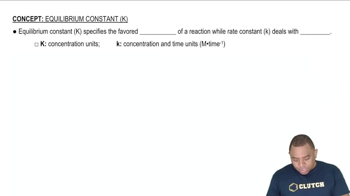
Equilibrium Constant

The equilibrium constant (K) is a numerical value that expresses the ratio of the concentrations of products to reactants at equilibrium for a given reaction. It remains constant at a specific temperature, but the presence of common ions does not change the value of K; instead, it affects the concentrations of the ions involved, thereby influencing solubility.
Video consigliato:
Percorso guidato
01:14
Equilibrium Constant K