(b) Use the energy requirements of these two pro- cesses to explain why photodissociation of oxygen is more important than photoionization of oxygen at altitudes below about 90 km.
Ch.18 - Chemistry of the Environment

Brown15th EditionChemistry: The Central ScienceISBN: 9780137542970Non è quello che usi tu?Cambia libro di testo
Capitolo 18, Problema 14
(b) What is the concentration of neon in the atmosphere in molecules per liter, assuming an atmospheric pressure of 730 torr and a temperature of 296 K?
Guida verificata passo dopo passo1
Step 1: Convert the atmospheric pressure from torr to atm. Use the conversion factor: 1 atm = 760 torr.
Step 2: Use the Ideal Gas Law equation, PV = nRT, to find the number of moles of neon per liter. Here, P is the pressure in atm, V is the volume in liters (1 L for simplicity), n is the number of moles, R is the ideal gas constant (0.0821 L·atm/mol·K), and T is the temperature in Kelvin.
Step 3: Rearrange the Ideal Gas Law equation to solve for n (moles of gas): n = PV / RT.
Step 4: Calculate the number of moles of neon using the values from Step 1 and the given temperature.
Step 5: Convert the moles of neon to molecules using Avogadro's number (6.022 x 10^23 molecules/mol) to find the concentration of neon in molecules per liter.
Concetti chiave
Ecco i concetti essenziali che devi comprendere per rispondere correttamente alla domanda.
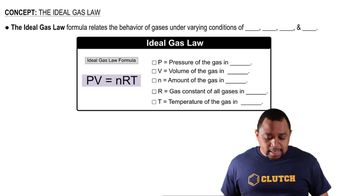
Ideal Gas Law
The Ideal Gas Law is a fundamental equation in chemistry that relates the pressure, volume, temperature, and number of moles of a gas. It is expressed as PV = nRT, where P is pressure, V is volume, n is the number of moles, R is the ideal gas constant, and T is temperature in Kelvin. This law allows us to calculate the concentration of gases under specific conditions.
Video consigliato:
Percorso guidato
Ideal Gas Law Formula
Molar Volume of a Gas
At standard temperature and pressure (STP), one mole of an ideal gas occupies 22.4 liters. However, under different conditions, such as varying pressure and temperature, the volume occupied by a mole of gas changes. Understanding how to adjust for these conditions is crucial for calculating the concentration of gases in the atmosphere.
Video consigliato:
Percorso guidato
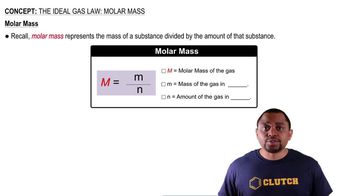
The Ideal Gas Law: Molar Mass
Concentration in Molecules per Liter
Concentration can be expressed in various units, including moles per liter (M) or molecules per liter. To convert from moles to molecules, Avogadro's number (approximately 6.022 x 10^23 molecules per mole) is used. This conversion is essential for determining the number of gas molecules present in a given volume, particularly in atmospheric chemistry.
Video consigliato:
Percorso guidato
Parts per Billion Example
Pratica correlata
Domanda del libro di testo
520
views
Domanda del libro di testo
From the data in Table 18.1, calculate the partial pressures of carbon dioxide and argon when the total atmospheric pressure is 1.05 bar.
1206
views
Domanda del libro di testo
The dissociation energy of a carbon-bromine bond is typically about 276 kJ/mol. (a) What is the maximum wavelength of photons that can cause C-Br bond dissociation?
1346
views
Domanda del libro di testo
Air pollution in the Mexico City metropolitan area is among the worst in the world. The concentration of ozone in Mexico City has been measured at 441 ppb (0.441 ppm). Mexico City sits at an altitude of 7400 feet, which means its atmospheric pressure is only 0.67 atm. (b) How many ozone molecules are in 1.0 L of air in Mexico City? Assume T = 25 °C.
1175
views