Ch.18 - Chemistry of the Environment
Brown - Chemistry: The Central Science 15th Edition
Brown15th EditionChemistry: The Central ScienceISBN: 9780137542970Non è quello che usi tu?Cambia libro di testo
Capitolo 18, Problema 16

In CF3Cl, the C-Cl bond dissociation energy is 339 kJ/mol. In CCl4, the C-Cl bond dissociation energy is 293 kJ/mol. What is the range of wavelengths of photons that can cause C-Cl bond rupture in one molecule but not in the other?

Guida verificata passo dopo passo
1
Step 1: Understand the concept of bond dissociation energy, which is the energy required to break a bond in a molecule. Here, we have two different C-Cl bonds with different dissociation energies: 339 kJ/mol for CF3Cl and 293 kJ/mol for CCl4.
Step 2: Convert the bond dissociation energies from kJ/mol to energy per photon. Use the formula: Energy per photon (J) = (Bond dissociation energy (kJ/mol) * 1000 J/kJ) / Avogadro's number (6.022 x 10^23 mol^-1).
Step 3: Calculate the frequency of the photon required to break the bond using the energy per photon. Use the formula: Frequency (ν) = Energy per photon (J) / Planck's constant (6.626 x 10^-34 J·s).
Step 4: Convert the frequency to wavelength using the speed of light. Use the formula: Wavelength (λ) = Speed of light (c, approximately 3.00 x 10^8 m/s) / Frequency (ν).
Step 5: Determine the range of wavelengths that can break the C-Cl bond in one molecule but not the other by comparing the wavelengths calculated for CF3Cl and CCl4.

Concetti chiave

Ecco i concetti essenziali che devi comprendere per rispondere correttamente alla domanda.

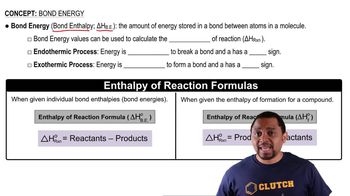
Bond Dissociation Energy

Bond dissociation energy (BDE) is the energy required to break a bond in a molecule, resulting in the formation of separate atoms or radicals. It is a crucial factor in determining the stability of a molecule; higher BDE indicates a stronger bond. In the context of the question, the differing BDEs of C-Cl bonds in CF3Cl and CCl4 suggest that different amounts of energy (and thus different photon wavelengths) are needed to break these bonds.
Video consigliato:

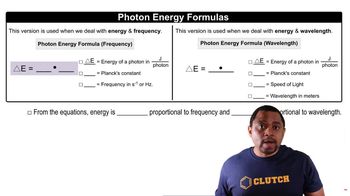
Photon Energy and Wavelength

The energy of a photon is inversely related to its wavelength, described by the equation E = hc/λ, where E is energy, h is Planck's constant, c is the speed of light, and λ is the wavelength. To cause bond rupture, the energy of the photon must match or exceed the bond dissociation energy. Therefore, the range of wavelengths that can cause C-Cl bond rupture in CF3Cl and CCl4 can be calculated based on their respective BDEs.
Video consigliato:
Percorso guidato
01:40
Photon Energy Formulas

Energy Threshold for Bond Rupture

The energy threshold for bond rupture is the minimum energy required to break a specific bond in a molecule. In this scenario, the C-Cl bond in CF3Cl has a higher energy threshold (339 kJ/mol) compared to CCl4 (293 kJ/mol). This difference means that photons with energies corresponding to wavelengths shorter than those calculated from these BDEs will be able to break the C-Cl bond in CF3Cl but not in CCl4, establishing a range of wavelengths for each molecule.
Video consigliato: