
Ch.19 - Chemical Thermodynamics
Brown - Chemistry: The Central Science 15th Edition
Brown15th EditionChemistry: The Central ScienceISBN: 9780137542970Non è quello che usi tu?Cambia libro di testo
Capitolo 19, Problema 66

A certain constant-pressure reaction is barely nonspontaneous at 45 °C. The entropy change for the reaction is 72 J/K. Estimate ΔH.

Guida verificata passo dopo passo
1
1. The spontaneity of a reaction is determined by the Gibbs free energy change (ΔG). If ΔG is negative, the reaction is spontaneous. If ΔG is positive, the reaction is nonspontaneous. In this case, we know the reaction is barely nonspontaneous, so ΔG is slightly positive.
2. The Gibbs free energy change is given by the equation ΔG = ΔH - TΔS, where ΔH is the enthalpy change, T is the temperature in Kelvin, and ΔS is the entropy change. We need to solve this equation for ΔH, which gives us ΔH = ΔG + TΔS.
3. We know that ΔG is slightly positive, but we don't know its exact value. However, because the reaction is barely nonspontaneous, we can assume that ΔG is very close to zero. This simplifies our equation to ΔH ≈ TΔS.
4. Convert the temperature from Celsius to Kelvin by adding 273.15 to the Celsius temperature. So, T = 45°C + 273.15 = 318.15 K.
5. Substitute the values of T and ΔS into the equation from step 3 to estimate ΔH. Remember to keep the units consistent, so convert the entropy change from J/K to kJ/K by dividing by 1000 if necessary.

Risposta video verificata per un problema simile:

Questa soluzione video è stata consigliata dai nostri tutor come utile per risolvere questo problema.
Durata del video:
2m

Concetti chiave

Ecco i concetti essenziali che devi comprendere per rispondere correttamente alla domanda.

Gibbs Free Energy

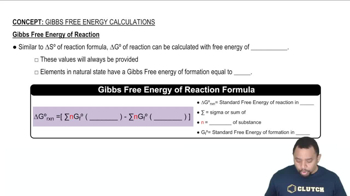
Gibbs Free Energy (ΔG) is a thermodynamic potential that helps predict the spontaneity of a reaction. A reaction is spontaneous when ΔG is negative. At equilibrium, ΔG equals zero, and for a reaction to be barely nonspontaneous, ΔG is close to zero, indicating that the enthalpy and entropy changes are in a delicate balance.
Video consigliato:
Percorso guidato
01:51
Gibbs Free Energy of Reactions

Entropy Change (ΔS)

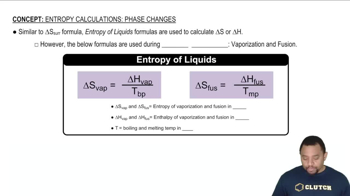
Entropy change (ΔS) measures the degree of disorder or randomness in a system. In this context, a positive ΔS of 72 J/K suggests that the reaction increases the disorder of the system. This increase in entropy can drive a reaction towards spontaneity, but it must be balanced with the enthalpy change (ΔH) to determine the overall spontaneity through Gibbs Free Energy.
Video consigliato:
Percorso guidato
01:46
Entropy in Phase Changes

Enthalpy Change (ΔH)

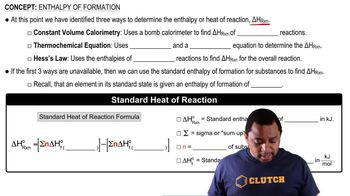
Enthalpy change (ΔH) represents the heat content of a system at constant pressure. It is a crucial factor in determining the energy required or released during a reaction. In the context of the question, we can use the relationship ΔG = ΔH - TΔS to estimate ΔH, knowing that the reaction is barely nonspontaneous at a specific temperature (45 °C).
Video consigliato:
Percorso guidato
02:34
Enthalpy of Formation