Ch.19 - Chemical Thermodynamics
Brown - Chemistry: The Central Science 15th Edition
Brown15th EditionChemistry: The Central ScienceISBN: 9780137542970Non è quello che usi tu?Cambia libro di testo
Capitolo 19, Problema 73

Acetylene gas, C2H2(g), is used in welding. (b) How much heat is produced in burning 1 mol of C2H2 under standard conditions if both reactants and products are brought to 298 K?

Guida verificata passo dopo passo
1
Identify the chemical reaction for the combustion of acetylene: \( \text{C}_2\text{H}_2(g) + \frac{5}{2} \text{O}_2(g) \rightarrow 2 \text{CO}_2(g) + \text{H}_2\text{O}(l) \).
Determine the standard enthalpy change of the reaction (\( \Delta H^\circ_{\text{rxn}} \)) using standard enthalpies of formation: \( \Delta H^\circ_{\text{rxn}} = \sum \Delta H^\circ_f(\text{products}) - \sum \Delta H^\circ_f(\text{reactants}) \).
Look up the standard enthalpies of formation for each substance involved in the reaction: \( \Delta H^\circ_f(\text{C}_2\text{H}_2(g)) \), \( \Delta H^\circ_f(\text{O}_2(g)) \), \( \Delta H^\circ_f(\text{CO}_2(g)) \), and \( \Delta H^\circ_f(\text{H}_2\text{O}(l)) \).
Substitute the values into the enthalpy change equation: \( \Delta H^\circ_{\text{rxn}} = [2 \times \Delta H^\circ_f(\text{CO}_2(g)) + \Delta H^\circ_f(\text{H}_2\text{O}(l))] - [\Delta H^\circ_f(\text{C}_2\text{H}_2(g)) + \frac{5}{2} \times \Delta H^\circ_f(\text{O}_2(g))] \).
Calculate the \( \Delta H^\circ_{\text{rxn}} \) to find the heat produced when 1 mol of \( \text{C}_2\text{H}_2 \) is burned under standard conditions.

Concetti chiave

Ecco i concetti essenziali che devi comprendere per rispondere correttamente alla domanda.

Combustion Reaction

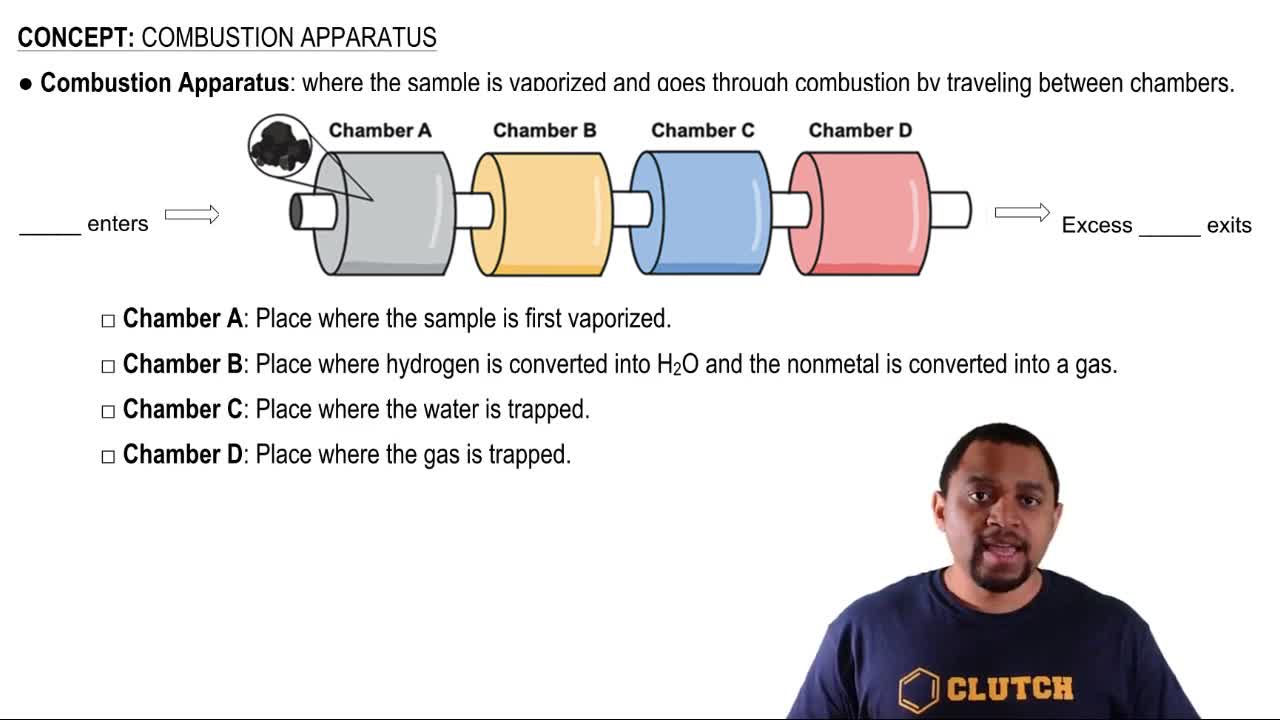
A combustion reaction is a chemical process in which a substance reacts rapidly with oxygen, producing heat and light. In the case of acetylene (C2H2), the combustion reaction involves its reaction with oxygen to form carbon dioxide (CO2) and water (H2O). Understanding this reaction is crucial for calculating the heat produced, as it defines the stoichiometry and products involved.
Video consigliato:
Percorso guidato
02:24
Combustion Apparatus

Enthalpy of Combustion

The enthalpy of combustion is the amount of heat released when one mole of a substance is completely burned in oxygen under standard conditions. This value is typically expressed in kilojoules per mole (kJ/mol) and is essential for determining the total heat produced in the combustion of acetylene. It can be found in thermodynamic tables or calculated using Hess's law.
Video consigliato:
Percorso guidato
02:24
Combustion Apparatus

Standard Conditions

Standard conditions refer to a set of specific conditions used as a reference point in thermodynamics, typically defined as 1 atmosphere of pressure and a temperature of 298 K (25°C). These conditions are important for ensuring consistency in thermodynamic measurements and calculations, such as determining the enthalpy of combustion, which is often reported under these standard conditions.
Video consigliato:
Percorso guidato
01:10
Standard Reduction Potentials