
Ch.19 - Chemical Thermodynamics
Brown - Chemistry: The Central Science 15th Edition
Brown15th EditionChemistry: The Central ScienceISBN: 9780137542970Non è quello che usi tu?Cambia libro di testo
Capitolo 19, Problema 85d

(d) For a reversible isothermal process, write an expression for ΔE in terms of q and w and an expression for ΔS in terms of q and T.

Guida verificata passo dopo passo
1
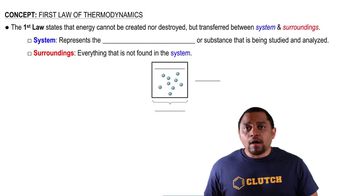
Identify the first law of thermodynamics, which states that the change in internal energy of a system (\(\Delta E\)) is equal to the heat added to the system (q) minus the work done by the system (w). Mathematically, it is expressed as \(\Delta E = q - w\).
Recognize that for a reversible isothermal process, the temperature (T) remains constant. In such processes, any heat added to the system is used to perform work or increase the internal energy.
Write the expression for \(\Delta E\) in terms of q and w for a reversible isothermal process as \(\Delta E = q - w\).
Understand the definition of entropy change (\(\Delta S\)), which is the heat transferred reversibly divided by the temperature at which the transfer occurs. For a reversible process, this is given by \(\Delta S = \frac{q_{\text{rev}}}{T}\).
Write the expression for \(\Delta S\) in terms of q and T for a reversible isothermal process as \(\Delta S = \frac{q}{T}\), where q is the heat involved in the reversible process.

Risposta video verificata per un problema simile:

Questa soluzione video è stata consigliata dai nostri tutor come utile per risolvere questo problema.
Durata del video:
3m

Concetti chiave

Ecco i concetti essenziali che devi comprendere per rispondere correttamente alla domanda.

First Law of Thermodynamics

The First Law of Thermodynamics states that energy cannot be created or destroyed, only transformed. In the context of a reversible isothermal process, the change in internal energy (ΔE) is equal to the heat added to the system (q) minus the work done by the system (w). This relationship is crucial for understanding how energy transfers occur in thermodynamic processes.
Video consigliato:
Percorso guidato
01:18
First Law of Thermodynamics

Isothermal Process

An isothermal process is one that occurs at a constant temperature. During such a process, the internal energy of an ideal gas remains constant, as it is a function of temperature alone. This characteristic allows for the simplification of the relationship between heat (q), work (w), and internal energy (ΔE) in the context of thermodynamic equations.
Video consigliato:
Percorso guidato
04:20
Spontaneity of Processes

Entropy (ΔS)

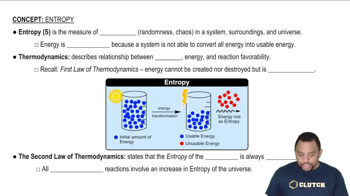
Entropy (ΔS) is a measure of the disorder or randomness in a system. For a reversible isothermal process, the change in entropy can be expressed as ΔS = q/T, where q is the heat exchanged and T is the absolute temperature. This relationship highlights how energy dispersal contributes to the overall disorder of a system, which is a fundamental concept in thermodynamics.
Video consigliato:
Percorso guidato
02:46
Entropy in Thermodynamics
Pratica correlata
Domanda del libro di testo

For each of the following processes, indicate whether the signs of ΔS and ΔH are expected to be positive, negative, or about zero. (a) A solid sublimes. (b) The temperature of a sample of Co(s) is lowered from 60 °C to 25 °C. (c) Ethyl alcohol evaporates from a beaker. (d) A diatomic molecule dissociates into atoms. (e) A piece of charcoal is combusted to form CO2(g) and H2O(g).

794
views
Domanda del libro di testo

The Kb for methylamine (CH3NH2) at 25 °C is given in Appendix D. (d) What is the value of ΔG when [H+] = 6.7 × 10⁻⁹ M, [CH3NH3+] = 2.4 × 10⁻³ M, and [CH3NH2] = 0.098 M?

Domanda del libro di testo

The crystalline hydrate Cd(NO3)2⋅4 H2O(s) loses water when placed in a large, closed, dry vessel at room temperature: Cd(NO3)2⋅4 H2O(s) → Cd(NO3)2(s) + 4 H2O(g) This process is spontaneous and ΔH° is positive at room temperature.

(b) If the hydrated compound is placed in a large, closed vessel that already contains a large amount of water vapor, does ΔS° change for this reaction at room temperature?

367
views
Domanda del libro di testo

(a) Which of the thermodynamic quantities T, E, q, w, and S are state functions? (b) Which depend on the path taken from one state to another?

568
views
Domanda del libro di testo

The Kb for methylamine (CH3NH2) at 25 °C is given in Appendix D. (a) Write the chemical equation for the equilibrium that corresponds to Kb.

610
views
Domanda del libro di testo

The crystalline hydrate Cd(NO3)2⋅4 H2O(s) loses water when placed in a large, closed, dry vessel at room temperature: Cd(NO3)2⋅4 H2O(s) → Cd(NO3)2(s) + 4 H2O(g) This process is spontaneous and ΔH° is positive at room temperature.

(a) What is the sign of ΔS° at room temperature?