Ch.19 - Chemical Thermodynamics
Brown - Chemistry: The Central Science 15th Edition
Brown15th EditionChemistry: The Central ScienceISBN: 9780137542970Non è quello che usi tu?Cambia libro di testo
Capitolo 19, Problema 55c,d

For a certain chemical reaction, ΔH° = -35.4 kJ and ΔS° = -85.5 J/K. (c) Calculate ΔG° for the reaction at 298 K. (d) Is the reaction spontaneous at 298 K under standard conditions?

Guida verificata passo dopo passo
1
To calculate the standard Gibbs free energy change (ΔG°) for the reaction, use the equation: ΔG° = ΔH° - TΔS°. Here, ΔH° is given in kJ, so convert ΔS° from J/K to kJ/K by dividing by 1000.
Substitute the given values into the equation: ΔG° = (-35.4 kJ) - (298 K) * (-85.5 J/K / 1000).
Perform the multiplication: (298 K) * (-85.5 J/K / 1000) to find the TΔS° term in kJ.
Subtract the TΔS° value from ΔH° to find ΔG°.
To determine if the reaction is spontaneous at 298 K, check the sign of ΔG°. If ΔG° is negative, the reaction is spontaneous under standard conditions.

Risposta video verificata per un problema simile:

Questa soluzione video è stata consigliata dai nostri tutor come utile per risolvere questo problema.

Concetti chiave

Ecco i concetti essenziali che devi comprendere per rispondere correttamente alla domanda.

Gibbs Free Energy (ΔG°)

Gibbs Free Energy (ΔG°) is a thermodynamic potential that measures the maximum reversible work obtainable from a thermodynamic system at constant temperature and pressure. It is calculated using the equation ΔG° = ΔH° - TΔS°, where ΔH° is the change in enthalpy, T is the temperature in Kelvin, and ΔS° is the change in entropy. A negative ΔG° indicates that a reaction is spontaneous under the given conditions.
Video consigliato:
Percorso guidato
01:51
Gibbs Free Energy of Reactions

Enthalpy (ΔH°)

Enthalpy (ΔH°) is a measure of the total heat content of a system and reflects the energy required to break and form bonds during a chemical reaction. A negative ΔH° value, such as -35.4 kJ, indicates that the reaction releases heat, making it exothermic. This release of energy can contribute to the spontaneity of the reaction.
Video consigliato:
Percorso guidato
02:34
Enthalpy of Formation

Entropy (ΔS°)

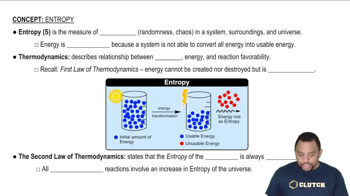
Entropy (ΔS°) is a measure of the disorder or randomness in a system. A negative ΔS° value, like -85.5 J/K, suggests that the reaction leads to a decrease in disorder, which can hinder spontaneity. In thermodynamics, the balance between enthalpy and entropy changes determines whether a reaction will occur spontaneously at a given temperature.
Video consigliato:
Percorso guidato
02:46
Entropy in Thermodynamics