
Ch.19 - Chemical Thermodynamics
Brown - Chemistry: The Central Science 15th Edition
Brown15th EditionChemistry: The Central ScienceISBN: 9780137542970Non è quello che usi tu?Cambia libro di testo
Capitolo 19, Problema 104d

The reaction SO2(g) + 2 H2S(g) ⇌ 3 S(s) + 2 H2O(g) is the basis of a suggested method for removal of SO2 from power-plant stack gases. The standard free energy of each substance is given in Appendix C. (d) Would you expect the process to be more or less effective at higher temperatures?

Guida verificata passo dopo passo
1
Identify the reaction: SO_2(g) + 2 H_2S(g) ⇌ 3 S(s) + 2 H_2O(g).
Determine the standard free energy change (ΔG°) for the reaction using the formula: ΔG° = ΣΔG°(products) - ΣΔG°(reactants).
Consider the effect of temperature on the reaction's spontaneity. If ΔG° is negative, the reaction is spontaneous at standard conditions. If positive, it is non-spontaneous.
Apply the Gibbs free energy equation: ΔG = ΔH - TΔS, where ΔH is the enthalpy change and ΔS is the entropy change. Analyze how increasing temperature (T) affects ΔG.
Conclude whether the reaction becomes more or less spontaneous at higher temperatures based on the signs of ΔH and ΔS.

Risposta video verificata per un problema simile:

Questa soluzione video è stata consigliata dai nostri tutor come utile per risolvere questo problema.
Durata del video:
5m

Concetti chiave

Ecco i concetti essenziali che devi comprendere per rispondere correttamente alla domanda.

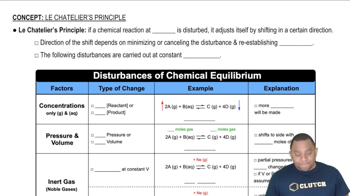
Le Chatelier's Principle

Le Chatelier's Principle states that if a dynamic equilibrium is disturbed by changing the conditions, the system will adjust to counteract the change and restore a new equilibrium. In the context of temperature changes, if the reaction is exothermic, increasing the temperature will shift the equilibrium to favor the reactants, while decreasing the temperature will favor the products.
Video consigliato:
Percorso guidato
07:32
Le Chatelier's Principle

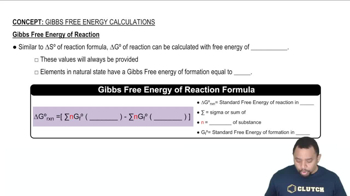
Gibbs Free Energy

Gibbs Free Energy (G) is a thermodynamic potential that measures the maximum reversible work obtainable from a thermodynamic system at constant temperature and pressure. The change in Gibbs Free Energy (ΔG) during a reaction indicates whether the process is spontaneous; a negative ΔG suggests that the reaction can occur spontaneously, while a positive ΔG indicates non-spontaneity.
Video consigliato:
Percorso guidato
01:51
Gibbs Free Energy of Reactions

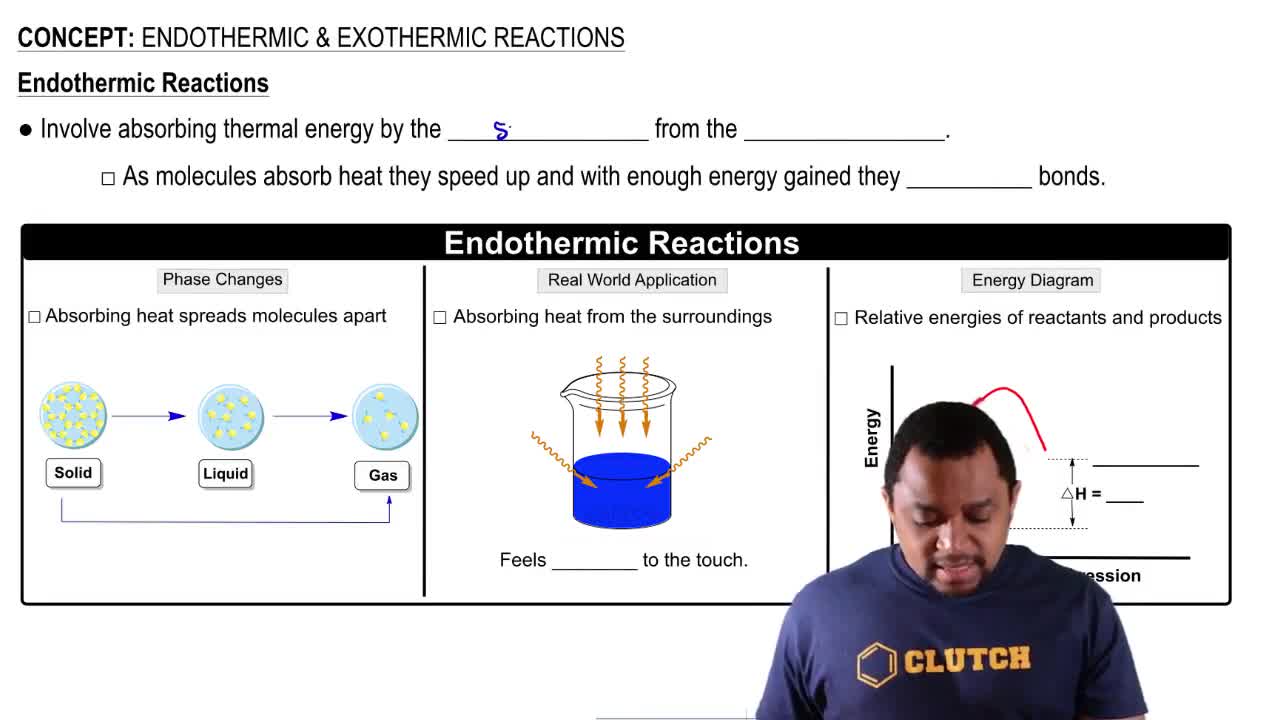
Endothermic vs. Exothermic Reactions

Reactions can be classified as endothermic or exothermic based on their heat exchange with the surroundings. Exothermic reactions release heat, leading to an increase in temperature, while endothermic reactions absorb heat, resulting in a decrease in temperature. Understanding the nature of the reaction in question is crucial for predicting how temperature changes will affect the equilibrium position.
Video consigliato:
Percorso guidato
02:30
Endothermic & Exothermic Reactions