Ch.19 - Chemical Thermodynamics
Brown - Chemistry: The Central Science 15th Edition
Brown15th EditionChemistry: The Central ScienceISBN: 9780137542970Non è quello che usi tu?Cambia libro di testo
Capitolo 19, Problema 1d

Two different gases occupy the two bulbs shown here. Consider the process that occurs when the stopcock is opened, assuming the gases behave ideally. (d) How does the process affect the entropy of the surroundings?

Guida verificata passo dopo passo
1
Identify the initial state of the system, where two different gases are separated in two bulbs connected by a closed stopcock.
Recognize that upon opening the stopcock, the gases will mix due to their natural tendency to spread out and occupy the available volume, leading to diffusion.
Understand that the mixing of gases is a spontaneous process at constant temperature and pressure, which increases the entropy of the system.
Consider the definition of entropy as a measure of disorder or randomness in a system. The mixing of two different gases increases the disorder, thus increasing the entropy of the system.
Since the process is spontaneous and the entropy of the system increases, the entropy of the surroundings remains unchanged because the process occurs at constant temperature and there is no heat exchange with the surroundings.

Risposta video verificata per un problema simile:

Questa soluzione video è stata consigliata dai nostri tutor come utile per risolvere questo problema.
Durata del video:
2m

Concetti chiave

Ecco i concetti essenziali che devi comprendere per rispondere correttamente alla domanda.

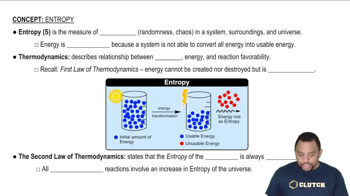
Entropy

Entropy is a measure of the disorder or randomness in a system. In thermodynamics, it quantifies the number of ways a system can be arranged, with higher entropy indicating greater disorder. When gases mix, the increase in the number of possible arrangements leads to an increase in entropy, reflecting a more probable state.
Video consigliato:
Percorso guidato
02:46
Entropy in Thermodynamics

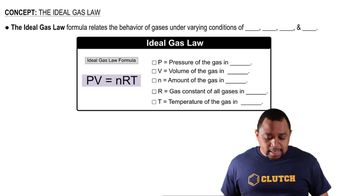
Ideal Gas Behavior

Ideal gas behavior refers to the theoretical model where gases are assumed to have no intermolecular forces and occupy no volume. This model simplifies the analysis of gas behavior under various conditions, allowing predictions about pressure, volume, and temperature relationships. In this scenario, the gases' ideal behavior implies that they will mix completely and uniformly when the stopcock is opened.
Video consigliato:
Percorso guidato
01:15
Ideal Gas Law Formula

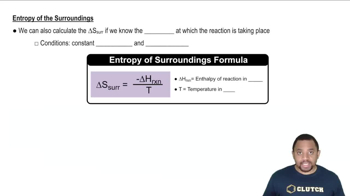
Surroundings and System Interaction

In thermodynamics, the system is the part of the universe being studied, while the surroundings encompass everything else. When the stopcock is opened, the mixing of gases affects the surroundings by potentially changing temperature and pressure, which can lead to energy exchanges. This interaction is crucial for understanding how the entropy of the surroundings changes as the gases mix.
Video consigliato:
Percorso guidato
00:53
Entropy of Surroundings Formula