Ch.19 - Chemical Thermodynamics
Brown - Chemistry: The Central Science 15th Edition
Brown15th EditionChemistry: The Central ScienceISBN: 9780137542970Non è quello che usi tu?Cambia libro di testo
Capitolo 19, Problema 11d

Which of the following processes are spontaneous and which are nonspontaneous: (d) lightning

Guida verificata passo dopo passo
1
Understand the concept of spontaneity: A spontaneous process occurs without any external intervention, driven by a decrease in free energy (Gibbs free energy, \( \Delta G < 0 \)).
Consider the nature of lightning: Lightning is a natural electrical discharge that occurs in the atmosphere, typically during a thunderstorm.
Analyze the conditions for lightning: It occurs when there is a significant build-up of electrical charge in clouds, leading to a potential difference that exceeds the insulating capacity of the air.
Evaluate the spontaneity: Since lightning occurs naturally and without external intervention once the conditions are met, it is considered a spontaneous process.
Conclude: Lightning is a spontaneous process because it happens naturally under the right atmospheric conditions without any external force.

Risposta video verificata per un problema simile:

Questa soluzione video è stata consigliata dai nostri tutor come utile per risolvere questo problema.
Durata del video:
1m

Concetti chiave

Ecco i concetti essenziali che devi comprendere per rispondere correttamente alla domanda.

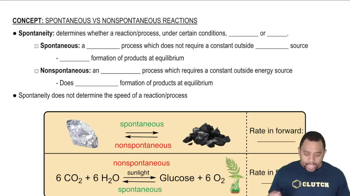
Spontaneity in Chemical Processes

Spontaneity refers to the natural tendency of a process to occur without external intervention. A spontaneous process is one that can proceed in a given direction under specified conditions, often associated with a decrease in free energy. Understanding spontaneity is crucial for predicting whether a reaction or physical change will happen on its own.
Video consigliato:
Percorso guidato
04:20
Spontaneity of Processes

Thermodynamics and Free Energy

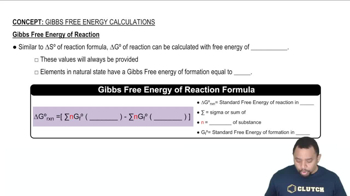
Thermodynamics is the study of energy transformations, and free energy (Gibbs free energy) is a key concept that helps determine spontaneity. A process is spontaneous if it results in a decrease in free energy (ΔG < 0). This principle allows chemists to assess whether a reaction will occur under certain conditions based on energy changes.
Video consigliato:
Percorso guidato
01:51
Gibbs Free Energy of Reactions

Examples of Spontaneous Processes

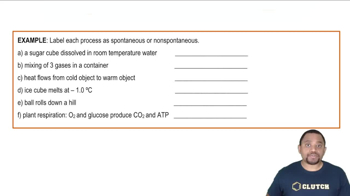
Spontaneous processes can include both chemical reactions and physical changes, such as the formation of lightning. Lightning occurs spontaneously due to the buildup of electrical charges in clouds, which eventually discharge when the potential difference is sufficient. Recognizing real-world examples helps illustrate the concept of spontaneity in various contexts.
Video consigliato:
Percorso guidato
03:05
Spontaneity of Processes Example
Pratica correlata
Domanda del libro di testo

Consider a reaction A2(𝑔) + B2(𝑔) ⇌ 2 AB(𝑔), atoms of A shown in red in the diagram and atoms of B shown in blue. (a) If 𝐾𝑐 = 1, which box represents the system at equilibrium?

319
views

Domanda del libro di testo

Indicate whether each statement is true or false. (a) A reaction that is spontaneous in one direction will be nonspontaneous in the reverse direction under the same reaction conditions. (b) All spontaneous processes are fast. (c) Most spontaneous processes are reversible. (d) An isothermal process is one in which the system loses no heat. (e) The maximum amount of work can be accomplished by an irreversible process rather than a reversible one.

931
views
Domanda del libro di testo

Which of the following processes are spontaneous and which are nonspontaneous: (e) formation of CH4 and O2 molecules from CO2 and H2O at room temperature and 1 atm of pressure?

1390
views
Domanda del libro di testo

Which of the following processes are spontaneous?

a. the melting of ice cubes at −10 °C and 1 atm pressure

b. separating a mixture of N2 and O2 into two separate samples, one that is pure N2 and one that is pure O2

c. alignment of iron filings in a magnetic field

d. the reaction of hydrogen gas with oxygen gas to form water vapor at room temperature

e. the dissolution of HCl(g) in water to form concentrated hydrochloric acid

1083
views
Domanda del libro di testo

Consider a reaction A2(𝑔) + B2(𝑔) ⇌ 2 AB(𝑔), atoms of A shown in red in the diagram and atoms of B shown in blue. (b) If 𝐾𝑐 = 1, which box represents the system at 𝑄 < 𝐾𝑐?

496
views
Domanda del libro di testo

Which of the following processes are spontaneous and which are nonspontaneous: (a) the ripening of a banana

760
views