
Ch.2 - Atoms, Molecules, and Ions
Brown - Chemistry: The Central Science 15th Edition
Brown15th EditionChemistry: The Central ScienceISBN: 9780137542970Non è quello che usi tu?Cambia libro di testo
Capitolo 2, Problema 11c

A 1.0-g sample of carbon dioxide (CO2) is fully decomposed into its elements, yielding 0.273 g of carbon and 0.727 g of oxygen. If a sample of a different compound decomposes into 0.429 g of carbon and 0.571 g of oxygen, what is its ratio of the mass of O to C? (c) According to Dalton's atomic theory, what is the empirical formula of the second compound?

Guida verificata passo dopo passo
1
Calculate the mass ratio of oxygen to carbon for the second compound by dividing the mass of oxygen by the mass of carbon: \( \frac{0.571 \, \text{g O}}{0.429 \, \text{g C}} \).
Simplify the ratio obtained in step 1 to find the simplest whole number ratio. This can be done by dividing both the numerator and the denominator by the smaller of the two values.
Use the simplified ratio to determine the empirical formula. The ratio represents the relative number of moles of oxygen and carbon atoms in the compound.
Convert the mole ratio into subscripts in a chemical formula. If the ratio from step 2 is, for example, 1.33, this would suggest a subscript of 1 for carbon and approximately 1.33 for oxygen in the empirical formula.
Round the subscripts to the nearest whole number if necessary, to get the empirical formula of the compound. This rounding is based on the assumption that the empirical formula represents the simplest whole-number ratio of atoms in the compound.

Risposta video verificata per un problema simile:

Questa soluzione video è stata consigliata dai nostri tutor come utile per risolvere questo problema.
Durata del video:
4m

Concetti chiave

Ecco i concetti essenziali che devi comprendere per rispondere correttamente alla domanda.

Mass Ratio Calculation

To determine the ratio of the mass of oxygen to carbon in a compound, divide the mass of oxygen by the mass of carbon. This ratio provides insight into the relative proportions of elements in a compound, which is essential for understanding its composition and can help in deriving the empirical formula.
Video consigliato:
Percorso guidato
02:14
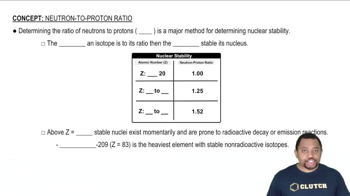
Neutron-Proton Ratio

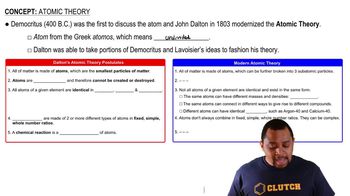
Dalton's Atomic Theory

Dalton's atomic theory posits that matter is composed of indivisible atoms, and compounds are formed when atoms of different elements combine in fixed ratios. This theory underpins the concept of empirical formulas, which represent the simplest whole-number ratio of the elements in a compound, reflecting the relative amounts of each element present.
Video consigliato:
Percorso guidato
05:22
Dalton's Atomic Theory

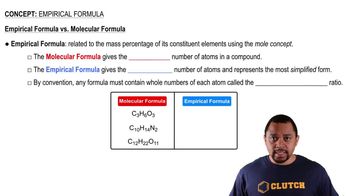
Empirical Formula

The empirical formula of a compound is the simplest integer ratio of the elements present in that compound. To derive it, one must first calculate the moles of each element from their masses, then simplify the ratio of these moles to the smallest whole numbers, which provides a clear representation of the compound's composition.
Video consigliato:
Percorso guidato
02:26
Empirical vs Molecular Formula
Pratica correlata
Domanda del libro di testo

A chemist finds that 30.82 g of nitrogen will react with 17.60, 35.20, 70.40, or 88.00 g of oxygen to form four different compounds. (a) Calculate the mass of oxygen per gram of nitrogen in each compound. 30.82 g N and 70.40 g O

371
views
Domanda del libro di testo

In the Millikan oil-drop experiment (see Figure 2.5), the tiny oil drops are observed through the viewing lens as rising, stationary, or falling, as shown here. The arrows indicate the rate of motion. a. What causes their rate of fall to vary from their rate in the absence of an electric field?

6
views
Domanda del libro di testo

Hydrogen sulfide is composed of two elements: hydrogen and sulfur. In an experiment, 6.500 g of hydrogen sulfide is fully decomposed into its elements. b. What fundamental law does this experiment demonstrate?

6
views
Domanda del libro di testo

A 1.0-g sample of carbon dioxide (CO2) is fully decomposed into its elements, yielding 0.273 g of carbon and 0.727 g of oxygen. (a) What is the ratio of the mass of O to C?

753
views
Domanda del libro di testo

A chemist finds that 30.82 g of nitrogen will react with 17.60, 35.20, 70.40, or 88.00 g of oxygen to form four different compounds. (a) Calculate the mass of oxygen per gram of nitrogen in each compound. 30.82 g N and 88.00 g O

1274
views
Domanda del libro di testo

A 1.0-g sample of carbon dioxide (CO2) is fully decomposed into its elements, yielding 0.273 g of carbon and 0.727 g of oxygen. (b) If a sample of a different compound decomposes into 0.429 g of carbon and 0.571 g of oxygen, what is its ratio of the mass of O to C?

829
views