Each of the following elements is capable of forming an ion in chemical reactions. By referring to the periodic table, predict the charge of the most stable ion of each: c. K
Ch.2 - Atoms, Molecules, and Ions

Brown15th EditionChemistry: The Central ScienceISBN: 9780137542970Non è quello che usi tu?Cambia libro di testo
Capitolo 2, Problema 58d
Using the periodic table, predict the charge of the most stable ion of the following elements: d. Br
Guida verificata passo dopo passo1
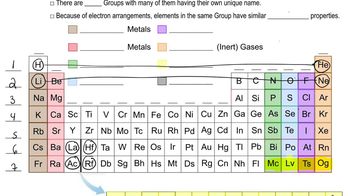
Identify the group number of bromine (Br) in the periodic table. Bromine is in Group 17, also known as the halogens.
Understand that elements in Group 17 typically gain one electron to achieve a full outer shell, similar to the nearest noble gas configuration.
Recognize that gaining one electron results in a negative charge. Therefore, the most stable ion of bromine will have a charge of -1.
Write the electron configuration of bromine: [Ar] 3d^{10} 4s^{2} 4p^{5}.
By gaining one electron, bromine achieves the electron configuration of krypton: [Ar] 3d^{10} 4s^{2} 4p^{6}, resulting in a Br^- ion.

Risposta video verificata per un problema simile:
Questa soluzione video è stata consigliata dai nostri tutor come utile per risolvere questo problema.
Durata del video:
1mConcetti chiave
Ecco i concetti essenziali che devi comprendere per rispondere correttamente alla domanda.
Periodic Table and Group Trends
The periodic table organizes elements based on their atomic number and properties. Elements in the same group (column) exhibit similar chemical behaviors, including their tendency to gain or lose electrons. For example, halogens like bromine (Br) are in Group 17 and typically gain one electron to achieve a stable electron configuration, resulting in a charge of -1.
Video consigliato:
Percorso guidato
Periodic Table: Group Names
Ion Formation and Stability
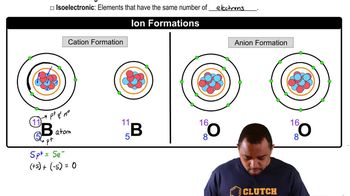
Ions are charged particles formed when atoms gain or lose electrons. The stability of an ion is often related to achieving a noble gas electron configuration, which is energetically favorable. For bromine, gaining one electron to form Br- allows it to mimic the electron configuration of the nearest noble gas, krypton, thus making it a stable ion.
Video consigliato:
Percorso guidato
Ion Formation
Electronegativity and Electron Affinity
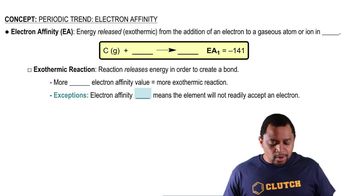
Electronegativity is a measure of an atom's ability to attract and hold onto electrons, while electron affinity refers to the energy change when an electron is added to a neutral atom. Bromine has high electronegativity and a significant electron affinity, indicating a strong tendency to gain an electron and form a stable anion (Br-), which is crucial for predicting its charge.
Video consigliato:
Percorso guidato
Electron Affinity
Pratica correlata
Domanda del libro di testo
2
views
Domanda del libro di testo
Fill in the gaps in the following table:
Symbol 31P3-
Protons 34 50
Neutrons 45 69 118
Electrons 46 76
Net charge 2- 3+
4
views
Domanda del libro di testo
Using the periodic table, predict the charge of the most stable ion of the following elements: e. Se
1
views
Domanda del libro di testo
Using the periodic table to guide you, predict the chemical formula and name of the compound formed by the following elements: (c) Al and I
997
views
Domanda del libro di testo
Using the periodic table to guide you, predict the chemical formula and name of the compound formed by the following elements: (a) Ga and F (b) Li and H
518
views
Domanda del libro di testo
Fill in the gaps in the following table: Symbol 59Co3+ Protons 34 76 80 Neutrons 46 116 120 Electrons 36 78 Net charge 2+
1573
views
1
comments