Ch.2 - Atoms, Molecules, and Ions
Brown - Chemistry: The Central Science 15th Edition
Brown15th EditionChemistry: The Central ScienceISBN: 9780137542970Non è quello che usi tu?Cambia libro di testo
Capitolo 2, Problema 24b

Consider an atom of 63Cu. b. What is the symbol of the ion obtained by removing two electrons from 63Cu?

Guida verificata passo dopo passo
1
Identify the element: The element with the atomic number 29 is copper (Cu).
Determine the charge of the ion: Removing two electrons from a neutral atom results in a 2+ charge.
Write the symbol for the ion: The ion symbol is the element symbol followed by the charge as a superscript.
Combine the element symbol and charge: The ion symbol for copper with a 2+ charge is \( \text{Cu}^{2+} \).
Verify the ion symbol: Ensure the charge and element symbol are correctly represented as \( \text{Cu}^{2+} \).

Risposta video verificata per un problema simile:

Questa soluzione video è stata consigliata dai nostri tutor come utile per risolvere questo problema.
Durata del video:
1m

Concetti chiave

Ecco i concetti essenziali che devi comprendere per rispondere correttamente alla domanda.

Atomic Structure

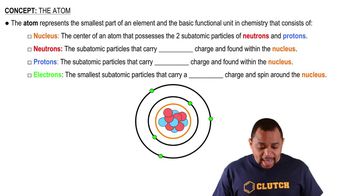
An atom consists of protons, neutrons, and electrons. The number of protons defines the element, while electrons determine the atom's charge and chemical behavior. In the case of copper (Cu), it has 29 protons and typically 29 electrons in its neutral state.
Video consigliato:

Ionic Charge

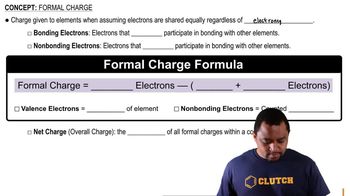
When an atom loses or gains electrons, it becomes an ion. Removing electrons results in a positive charge, as there are more protons than electrons. For copper, if two electrons are removed, the resulting ion will have a charge of +2, denoted as Cu²⁺.
Video consigliato:

Isotopes

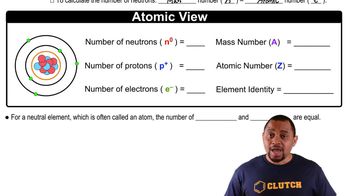
Isotopes are variants of an element that have the same number of protons but different numbers of neutrons. The notation 63Cu indicates that this isotope of copper has a mass number of 63, which is the sum of protons and neutrons. However, the isotopic identity does not affect the ionization process.
Video consigliato: