Ch.2 - Atoms, Molecules, and Ions
Brown - Chemistry: The Central Science 15th Edition
Brown15th EditionChemistry: The Central ScienceISBN: 9780137542970Non è quello che usi tu?Cambia libro di testo
Capitolo 2, Problema 29e

Fill in the gaps in the following table, assuming each column represents a neutral atom.
Symbol 79Br
Protons 25 82
Neutrons 30 64
Electrons 48 86
Mass no. 222 207


Complete the fifth row of the table.

Guida verificata passo dopo passo
1
Identify the missing information for the fifth row: the symbol, protons, neutrons, electrons, and mass number.
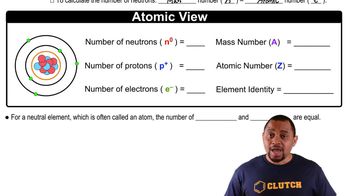
Use the given mass number (207) and the number of neutrons (64) to find the number of protons: Mass number = Protons + Neutrons, so Protons = Mass number - Neutrons.
Since the atom is neutral, the number of electrons equals the number of protons.
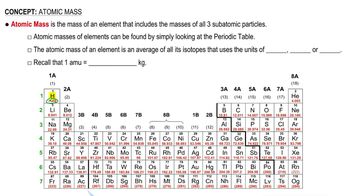
Use the number of protons to determine the element's symbol by referring to the periodic table.
Fill in the missing information in the table: symbol, protons, neutrons, electrons, and mass number.

Risposta video verificata per un problema simile:

Questa soluzione video è stata consigliata dai nostri tutor come utile per risolvere questo problema.
Durata del video:
1m

Concetti chiave

Ecco i concetti essenziali che devi comprendere per rispondere correttamente alla domanda.

Atomic Structure

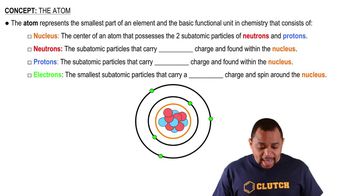
Atoms consist of protons, neutrons, and electrons. Protons are positively charged particles found in the nucleus, while neutrons are neutral particles also located in the nucleus. Electrons are negatively charged and orbit the nucleus. The number of protons defines the element, while the total number of protons and neutrons gives the atomic mass.
Video consigliato:

Isotopes

Isotopes are variants of a particular chemical element that have the same number of protons but different numbers of neutrons. This results in different atomic masses for the isotopes. For example, bromine-79 (79Br) has 35 protons and 44 neutrons, while another isotope may have a different neutron count, affecting its mass number.
Video consigliato:

Mass Number

The mass number of an atom is the sum of its protons and neutrons. It is a whole number that represents the total mass of the nucleus. In the context of the table, filling in the mass number requires adding the number of protons and neutrons for each atom, which helps in identifying the specific isotope and its properties.
Video consigliato:
Pratica correlata
Domanda del libro di testo

Fill in the gaps in the following table, assuming each column represents a neutral atom.

Symbol 112Cd

Protons 38 92

Neutrons 58 49

Electrons 38 36

Mass no. 81 235

Complete the second row of the table.

1238
views

Domanda del libro di testo

Fill in the gaps in the following table, assuming each column represents a neutral atom.

Symbol 112Cd

Protons 38 92

Neutrons 58 49

Electrons 38 36

Mass no. 81 235

Complete the first row of the table.

484
views
Domanda del libro di testo

Fill in the gaps in the following table, assuming each column represents a neutral atom.

Symbol 79Br

Protons 25 82

Neutrons 30 64

Electrons 48 86

Mass no. 222 207


Complete the fourth row of the table.

446
views
Domanda del libro di testo

Fill in the gaps in the following table, assuming each column represents a neutral atom.

Symbol 79Br

Protons 25 82

Neutrons 30 64

Electrons 48 86

Mass no. 222 207


Complete the third row of the table.

752
views
Domanda del libro di testo

Fill in the gaps in the following table, assuming each column represents a neutral atom.

Symbol 79Br

Protons 25 82

Neutrons 30 64

Electrons 48 86

Mass no. 222 207


Complete the first row of the table excluding the isotope symbol.

Complete the second row of the table excluding the row with isotope symbol.

561
views
Domanda del libro di testo

Fill in the gaps in the following table, assuming each column represents a neutral atom.

Symbol 112Cd

Protons 38 92

Neutrons 58 49

Electrons 38 36

Mass no. 81 235

Complete the third row of the table.

Complete the fourth row of the table.

636
views