Ch.2 - Atoms, Molecules, and Ions
Brown - Chemistry: The Central Science 15th Edition
Brown15th EditionChemistry: The Central ScienceISBN: 9780137542970Non è quello che usi tu?Cambia libro di testo
Capitolo 2, Problema 95a

Identify the element represented by each of the following symbols and give the number of protons and neutrons in each: (a) 7433X

Guida verificata passo dopo passo
1
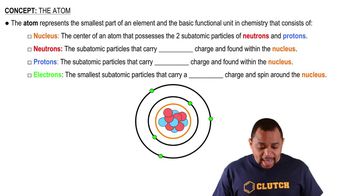
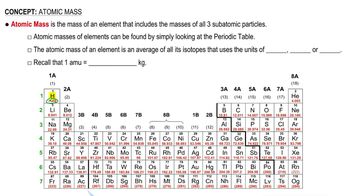
Step 1: The atomic number (the subscript) represents the number of protons in an atom. In this case, the atomic number is 33, which corresponds to the element Arsenic (As) in the periodic table.
Step 2: The atomic mass number (the superscript) represents the total number of protons and neutrons in an atom. In this case, the atomic mass number is 74.
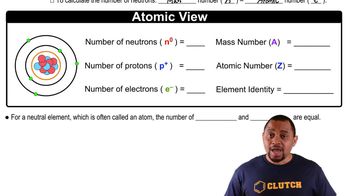
Step 3: To find the number of neutrons, subtract the atomic number (number of protons) from the atomic mass number. In this case, 74 (atomic mass number) - 33 (atomic number) = 41.
Step 4: Therefore, the element represented by the symbol 7433X is Arsenic (As), which has 33 protons and 41 neutrons.

Risposta video verificata per un problema simile:

Questa soluzione video è stata consigliata dai nostri tutor come utile per risolvere questo problema.
Durata del video:
3m

Concetti chiave

Ecco i concetti essenziali che devi comprendere per rispondere correttamente alla domanda.

Atomic Number

The atomic number of an element is the number of protons found in the nucleus of an atom. It uniquely identifies an element and determines its position on the periodic table. In the notation <sup>74</sup><sub>33</sub>X, the subscript '33' represents the atomic number, indicating that the element has 33 protons.
Video consigliato:

Mass Number

The mass number of an atom is the total number of protons and neutrons in its nucleus. It is represented by the superscript in the notation <sup>74</sup><sub>33</sub>X, where '74' is the mass number. To find the number of neutrons, subtract the atomic number from the mass number: neutrons = mass number - atomic number.
Video consigliato:

Isotopes

Isotopes are variants of a particular chemical element that have the same number of protons but different numbers of neutrons. This results in different mass numbers for the isotopes of the same element. In the case of <sup>74</sup><sub>33</sub>X, knowing the mass number allows us to identify the specific isotope of the element with atomic number 33, which is arsenic.
Video consigliato:
Pratica correlata
Domanda del libro di testo

The element oxygen has three naturally occurring isotopes, with 8, 9, and 10 neutrons in the nucleus, respectively. a. Write the full chemical symbols for these three isotopes.

2
views

Domanda del libro di testo

The nucleus of 6Li is a powerful absorber of neutrons. It exists in the naturally occurring metal to the extent of 7.5%. In the era of nuclear deterrence, large quantities of lithium were processed to remove 6Li for use in hydrogen bomb production. The lithium metal remaining after removal of 6Li was sold on the market. (b) The atomic masses of 6Li and 7Li are 6.015122 and 7.016004 u, respectively. A sample of lithium depleted in the lighter isotope was found on analysis to contain 1.442% 6Li. What is the average atomic weight of this sample of the metal?

935
views
Domanda del libro di testo

The natural abundance of 3He is 0.000137%. (a) How many protons, neutrons, and electrons are in an atom of 3He?

807
views
Domanda del libro di testo

The natural abundance of 3He is 0.000137%. (b) Based on the sum of the masses of their subatomic particles, which is expected to be more massive, an atom of 3He or an atom of 3H (which is also called tritium)?

906
views
Domanda del libro di testo

The natural abundance of 3He is 0.000137%. (c) Based on your answer to part (b), what would need to be the precision of a mass spectrometer that is able to differentiate between peaks that are due to 3He+ and 3H+?

565
views
Domanda del libro di testo

Identify the element represented by each of the following symbols and give the number of protons and neutrons in each: (b) 12753X (c) 8636X (d) 6730X

520
views