
Ch.2 - Atoms, Molecules, and Ions
Brown - Chemistry: The Central Science 15th Edition
Brown15th EditionChemistry: The Central ScienceISBN: 9780137542970Non è quello che usi tu?Cambia libro di testo
Capitolo 2, Problema 33

The atomic weight of boron is reported as 10.81, yet no atom of boron has the mass of 10.81 amu. Which is the best explanation?
a. The measurement of atomic mass is only reliable to two significant figures.
b. The atomic weight is an average of many individual atoms.
c. The atomic weight is an average of many isotopes of the same nuclear composition.

Guida verificata passo dopo passo
1
Understand that atomic weight is a weighted average of the masses of an element's isotopes.
Recognize that isotopes are atoms of the same element with different numbers of neutrons, resulting in different atomic masses.
Consider that the atomic weight reflects the relative abundance of each isotope in nature.
Note that the atomic weight is not the mass of a single atom but an average value that accounts for the distribution of isotopes.
Conclude that the best explanation is that the atomic weight is an average of many isotopes of the same element, which corresponds to option b.

Risposta video verificata per un problema simile:

Questa soluzione video è stata consigliata dai nostri tutor come utile per risolvere questo problema.
Durata del video:
2m

Concetti chiave

Ecco i concetti essenziali che devi comprendere per rispondere correttamente alla domanda.

Atomic Weight vs. Atomic Mass

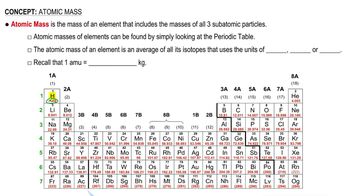
Atomic weight is a weighted average of the masses of an element's isotopes, reflecting their relative abundances in nature. In contrast, atomic mass refers to the mass of a specific isotope of an element, measured in atomic mass units (amu). This distinction is crucial for understanding why the atomic weight of boron is not a whole number.
Video consigliato:

Isotopes

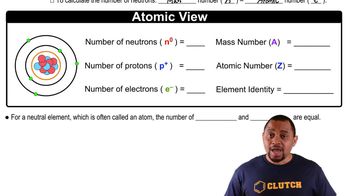
Isotopes are variants of a chemical element that have the same number of protons but different numbers of neutrons, resulting in different atomic masses. For boron, the most common isotopes are boron-10 and boron-11. The average atomic weight of boron (10.81) accounts for the natural abundance of these isotopes.
Video consigliato:

Average Atomic Weight Calculation

The average atomic weight is calculated by taking the sum of the products of the mass of each isotope and its relative abundance. This calculation provides a single value that represents the mass of an element as it occurs in nature, which explains why the atomic weight of boron is reported as 10.81, despite no individual boron atom having that exact mass.
Video consigliato:
Percorso guidato
02:42
Average Rate Calculation Example