Determine the molecular and empirical formulas of the following: (b) the compound silicon tetrachloride, which has a silicon atom and four chlorine atoms and is used in the manufacture of computer chips
Ch.2 - Atoms, Molecules, and Ions

Brown15th EditionChemistry: The Central ScienceISBN: 9780137542970Non è quello che usi tu?Cambia libro di testo
Capitolo 2, Problema 49c
Write the empirical formula corresponding to each of the following molecular formulas: (c) C4H8O2
Guida verificata passo dopo passo1
Identify the greatest common divisor (GCD) of the subscripts in the molecular formula C₄H₈O₂.
Divide each subscript in the molecular formula by the GCD to simplify the ratio of atoms.
Write the empirical formula using the simplified ratio of atoms obtained from the previous step.
Ensure that the empirical formula represents the simplest whole number ratio of the elements present in the compound.
Verify that the empirical formula cannot be further simplified by checking if the subscripts have any common factors other than 1.

Risposta video verificata per un problema simile:
Questa soluzione video è stata consigliata dai nostri tutor come utile per risolvere questo problema.
Durata del video:
1mConcetti chiave
Ecco i concetti essenziali che devi comprendere per rispondere correttamente alla domanda.
Empirical Formula
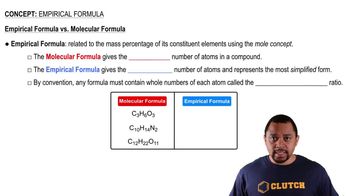
The empirical formula represents the simplest whole-number ratio of atoms of each element in a compound. It is derived from the molecular formula by dividing the subscripts of each element by their greatest common divisor. For example, the empirical formula of C4H8O2 is C2H4O, indicating that for every two carbon atoms, there are four hydrogen atoms and one oxygen atom.
Video consigliato:
Percorso guidato
Empirical vs Molecular Formula
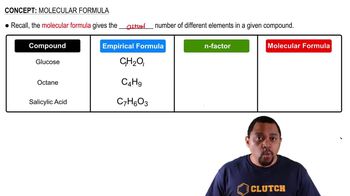
Molecular Formula
The molecular formula provides the actual number of atoms of each element in a molecule of a compound. It can be the same as the empirical formula or a multiple of it. In the case of C4H8O2, the molecular formula indicates that there are four carbon atoms, eight hydrogen atoms, and two oxygen atoms in each molecule, which can be simplified to its empirical form.
Video consigliato:
Percorso guidato
Determining Molecular Formulas
Greatest Common Divisor (GCD)
The greatest common divisor is the largest integer that divides the subscripts of the elements in a molecular formula without leaving a remainder. It is essential for simplifying the molecular formula to its empirical form. For C4H8O2, the GCD of the subscripts 4, 8, and 2 is 2, which is used to reduce the formula to C2H4O.
Video consigliato:
Percorso guidato
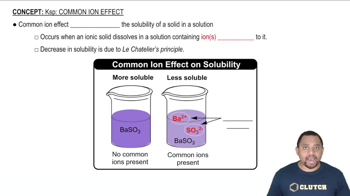
Common Ion Effect
Pratica correlata
Domanda del libro di testo
1131
views
Domanda del libro di testo
Two substances have the same molecular and empirical formulas. Does this mean that they must be the same compound?
922
views
Domanda del libro di testo
Write the empirical formula corresponding to each of the following molecular formulas: (b) C8H10
1017
views
Domanda del libro di testo
Write the empirical formula corresponding to each of the following molecular formulas: (a) Al2Br6
776
views
Domanda del libro di testo
Determine the molecular and empirical formulas of the following: (a) the organic solvent benzene, which has six carbon atoms and six hydrogen atoms
877
views
Domanda del libro di testo
Write the empirical formula corresponding to each of the following molecular formulas: (d) P4O10 (e) C6H4Cl2 (f) B3N3H6.
660
views