Ch.20 - Electrochemistry
Brown - Chemistry: The Central Science 15th Edition
Brown15th EditionChemistry: The Central ScienceISBN: 9780137542970Non è quello che usi tu?Cambia libro di testo
Capitolo 20, Problema 85a

(a) Which reaction is spontaneous in the hydrogen fuel cell: hydrogen gas plus oxygen gas makes water, or water makes hydrogen gas plus oxygen gas?

Guida verificata passo dopo passo
1
Identify the reactions involved in the hydrogen fuel cell. The two reactions to consider are: 1) Hydrogen gas (H2) reacting with oxygen gas (O2) to form water (H2O), and 2) Water (H2O) decomposing into hydrogen gas (H2) and oxygen gas (O2).
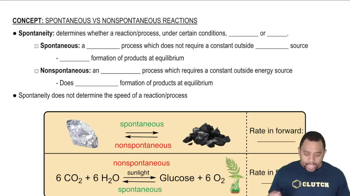
Understand the concept of spontaneity in chemical reactions. A spontaneous reaction is one that occurs naturally under certain conditions without the need for continuous external energy.
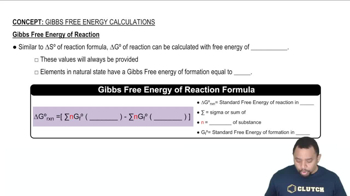
Consider the standard Gibbs free energy change (\(\Delta G^\circ\)) for each reaction. The sign of \(\Delta G^\circ\) helps determine spontaneity: if \(\Delta G^\circ < 0\), the reaction is spontaneous; if \(\Delta G^\circ > 0\), the reaction is non-spontaneous.
Recall the formation of water from hydrogen and oxygen (Reaction 1) is exothermic and releases energy, typically indicating a negative \(\Delta G^\circ\) and thus spontaneity under standard conditions.
Analyze the decomposition of water into hydrogen and oxygen (Reaction 2). This reaction requires an input of energy (endothermic), suggesting a positive \(\Delta G^\circ\) and thus it is non-spontaneous under standard conditions.

Risposta video verificata per un problema simile:

Questa soluzione video è stata consigliata dai nostri tutor come utile per risolvere questo problema.
Durata del video:
9m

Concetti chiave

Ecco i concetti essenziali che devi comprendere per rispondere correttamente alla domanda.

Spontaneity of Reactions

A reaction is considered spontaneous if it occurs naturally under given conditions without external influence. This is often determined by the change in Gibbs free energy (ΔG); if ΔG is negative, the reaction is spontaneous. In the context of the hydrogen fuel cell, understanding spontaneity helps in identifying which direction of the reaction is favored energetically.
Video consigliato:
Percorso guidato
04:20
Spontaneity of Processes

Gibbs Free Energy

Gibbs free energy is a thermodynamic potential that measures the maximum reversible work obtainable from a thermodynamic system at constant temperature and pressure. It combines the system's enthalpy and entropy to predict the direction of chemical reactions. A negative ΔG indicates that the products of a reaction are favored, which is crucial for determining the spontaneity of the reactions in a hydrogen fuel cell.
Video consigliato:
Percorso guidato
01:51
Gibbs Free Energy of Reactions

Electrochemical Reactions

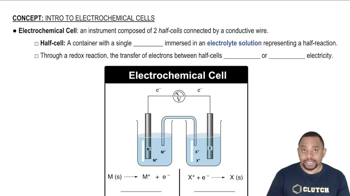
Electrochemical reactions involve the transfer of electrons between chemical species, which is fundamental in processes like those occurring in a hydrogen fuel cell. In these cells, hydrogen gas reacts with oxygen to produce water, releasing energy in the form of electricity. Understanding the nature of these reactions helps in analyzing which reaction direction is spontaneous and how energy is harnessed.
Video consigliato:
Percorso guidato
02:46
Electrochemical Cells