Ch.20 - Electrochemistry
Brown - Chemistry: The Central Science 15th Edition
Brown15th EditionChemistry: The Central ScienceISBN: 9780137542970Non è quello che usi tu?Cambia libro di testo
Capitolo 20, Problema 62

At 298 K a cell reaction has a standard cell potential of +0.17 V. The equilibrium constant for the reaction is 5.5 × 10⁵. What is the value of n for the reaction?

Guida verificata passo dopo passo
1
Identify the relationship between the standard cell potential (E°), the equilibrium constant (K), and the number of moles of electrons transferred (n) using the Nernst equation at equilibrium: E° = (RT/nF)ln(K).
Since the temperature is 298 K, use the simplified form of the Nernst equation: E° = (0.0257 V/n)ln(K).
Substitute the given values into the equation: 0.17 V = (0.0257 V/n)ln(5.5 × 10^5).
Solve for n by isolating it on one side of the equation: n = (0.0257 V/0.17 V)ln(5.5 × 10^5).
Calculate the natural logarithm of the equilibrium constant and then solve for n.

Risposta video verificata per un problema simile:

Questa soluzione video è stata consigliata dai nostri tutor come utile per risolvere questo problema.
Durata del video:
2m

Concetti chiave

Ecco i concetti essenziali che devi comprendere per rispondere correttamente alla domanda.

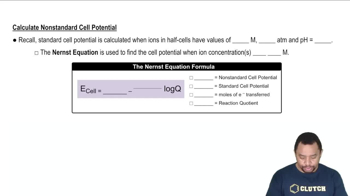
Nernst Equation

The Nernst Equation relates the cell potential of an electrochemical reaction to the concentrations of the reactants and products. It is expressed as E = E° - (RT/nF)ln(Q), where E is the cell potential, E° is the standard cell potential, R is the universal gas constant, T is the temperature in Kelvin, n is the number of moles of electrons transferred, F is Faraday's constant, and Q is the reaction quotient.
Video consigliato:
Percorso guidato
01:17
The Nernst Equation

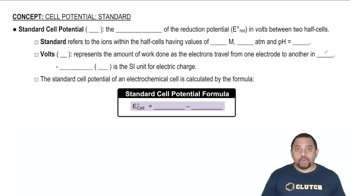
Standard Cell Potential (E°)

The standard cell potential (E°) is the voltage measured under standard conditions (1 M concentration, 1 atm pressure, and 25°C) for a galvanic cell. It indicates the tendency of a chemical reaction to occur spontaneously; a positive E° suggests a spontaneous reaction, while a negative E° indicates non-spontaneity.
Video consigliato:
Percorso guidato
01:27
Standard Cell Potential

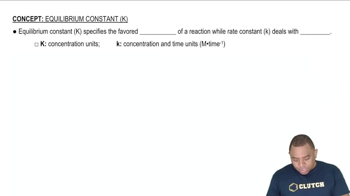
Equilibrium Constant (K)

The equilibrium constant (K) quantifies the ratio of the concentrations of products to reactants at equilibrium for a reversible reaction. It is related to the standard cell potential through the equation ΔG° = -nFE°, where ΔG° is the change in Gibbs free energy. A larger K value indicates a greater tendency for the reaction to favor products at equilibrium.
Video consigliato:
Percorso guidato
01:14
Equilibrium Constant K