By using the data in Appendix E, determine whether each of the following substances is likely to serve as an oxidant or a reductant: (a) Cl2(g), (b) MnO4- (aq, acidic solution), (c) Ba(s)
Ch.20 - Electrochemistry

Brown15th EditionChemistry: The Central ScienceISBN: 9780137542970Non è quello che usi tu?Cambia libro di testo
Capitolo 20, Problema 49d
By using the data in Appendix E, determine whether each of the following substances is likely to serve as an oxidant or a reductant: (d) Zn(s)
Guida verificata passo dopo passo1
Identify the standard reduction potential for the half-reaction involving Zn(s) from Appendix E.
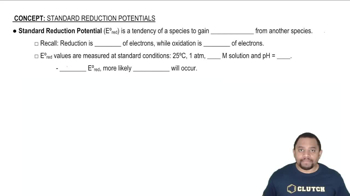
Recall that a substance with a more positive standard reduction potential is more likely to be reduced and act as an oxidant.
Conversely, a substance with a more negative standard reduction potential is more likely to be oxidized and act as a reductant.
Compare the standard reduction potential of Zn(s) with other substances to determine its tendency to act as an oxidant or reductant.
Conclude whether Zn(s) is more likely to serve as an oxidant or a reductant based on its standard reduction potential.

Risposta video verificata per un problema simile:
Questa soluzione video è stata consigliata dai nostri tutor come utile per risolvere questo problema.
Durata del video:
2mConcetti chiave
Ecco i concetti essenziali che devi comprendere per rispondere correttamente alla domanda.
Oxidation and Reduction
Oxidation and reduction are chemical processes that involve the transfer of electrons between substances. Oxidation refers to the loss of electrons, while reduction involves the gain of electrons. In redox reactions, one substance is oxidized and another is reduced, which is essential for understanding the roles of oxidants and reductants.
Video consigliato:
Percorso guidato
Oxidation and Reduction Reactions
Standard Reduction Potentials
Standard reduction potentials are values that indicate the tendency of a chemical species to be reduced, measured under standard conditions. These potentials are used to predict the direction of redox reactions and determine whether a substance will act as an oxidant or reductant. A higher reduction potential means a greater likelihood of being reduced.
Video consigliato:
Percorso guidato
Standard Reduction Potentials
Electrochemical Series
The electrochemical series is a list of standard reduction potentials for various half-reactions, arranged from highest to lowest. This series helps in identifying which substances can act as oxidants or reductants in a reaction. By comparing the position of a substance like Zn(s) in this series, one can infer its behavior in redox reactions.
Video consigliato:
Percorso guidato
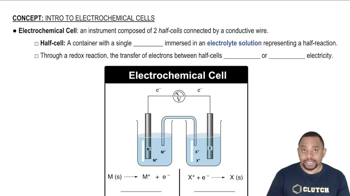
Electrochemical Cells
Pratica correlata
Domanda del libro di testo
567
views
Domanda del libro di testo
From each of the following pairs of substances, use data in Appendix E to choose the one that is the stronger reducing agent: (a) Fe(s) or Mg(s) (b) Ca(s) or Al(s) (c) H2(g, acidic solution) or H2S(g)
341
views
Domanda del libro di testo
(a) Assuming standard conditions, arrange the following in order of increasing strength as oxidizing agents in acidic solution: Cr2O72-, H2O2, Cu2+, Cl2, O2.
688
views
Domanda del libro di testo
Is each of the following substances likely to serve as an oxidant or a reductant: (a) Ce3+(aq) (b) Ca(s) (c) ClO3-(aq) (d) N2O5(g)?
350
views
Domanda del libro di testo
(b) Arrange the following in order of increasing strength as reducing agents in acidic solution: Zn, I-, Sn2+, H2O2, Al.