Ch.20 - Electrochemistry
Brown - Chemistry: The Central Science 15th Edition
Brown15th EditionChemistry: The Central ScienceISBN: 9780137542970Non è quello che usi tu?Cambia libro di testo
Capitolo 20, Problema 28

Complete and balance the following equations, and identify the oxidizing and reducing agents:


a. MnO4−(𝑎𝑞)+CH3OH(𝑎𝑞)⟶Mn2+(𝑎𝑞)+HCOOH(𝑎𝑞)(acidic solution)
b. As2O3(𝑠)+NO3−(𝑎𝑞)⟶H3AsO4(𝑎𝑞)+N2O3(𝑎𝑞)(acidic solution)
c. Pb(OH)42−(𝑎𝑞)+ClO−(𝑎𝑞)⟶PbO2(𝑠)+Cl−(𝑎𝑞)(basic solution)

Guida verificata passo dopo passo
1
Step 1: Identify the oxidation states of each element in the reactants and products for each equation to determine which elements are oxidized and reduced.
Step 2: Write the half-reactions for the oxidation and reduction processes separately for each equation.
Step 3: Balance each half-reaction for mass and charge. In acidic solutions, add H2O to balance oxygen and H+ to balance hydrogen. In basic solutions, add OH- to balance both hydrogen and oxygen.
Step 4: Multiply each half-reaction by appropriate coefficients so that the number of electrons lost in the oxidation half-reaction equals the number of electrons gained in the reduction half-reaction.
Step 5: Add the balanced half-reactions together, canceling out electrons and any other species that appear on both sides, to obtain the balanced overall equation. Identify the oxidizing agent (species that is reduced) and the reducing agent (species that is oxidized).

Risposta video verificata per un problema simile:

Questa soluzione video è stata consigliata dai nostri tutor come utile per risolvere questo problema.
Durata del video:
7m

Concetti chiave

Ecco i concetti essenziali che devi comprendere per rispondere correttamente alla domanda.

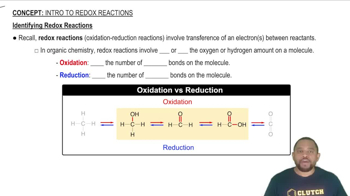
Redox Reactions

Redox reactions, or reduction-oxidation reactions, involve the transfer of electrons between species. In these reactions, one substance is oxidized (loses electrons) while another is reduced (gains electrons). Understanding the electron transfer is crucial for identifying the oxidizing and reducing agents in a reaction.
Video consigliato:
Percorso guidato
03:12
Identifying Redox Reactions

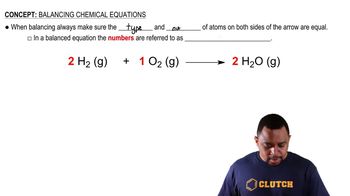
Balancing Chemical Equations

Balancing chemical equations ensures that the number of atoms for each element is the same on both sides of the equation, adhering to the law of conservation of mass. This process often involves adjusting coefficients and may require separate balancing of oxidation and reduction half-reactions in redox processes.
Video consigliato:
Percorso guidato
01:32
Balancing Chemical Equations

Oxidizing and Reducing Agents

The oxidizing agent is the species that gets reduced by gaining electrons, while the reducing agent is the species that gets oxidized by losing electrons. Identifying these agents is essential in redox reactions, as they play a key role in determining the direction of electron flow and the overall reaction mechanism.
Video consigliato:
Percorso guidato
01:01
Oxidizing and Reducing Agents
Pratica correlata
Domanda del libro di testo

Complete and balance the following equations, and identify the oxidizing and reducing agents: As2O3(s) + NO3-(aq) → H3AsO4(aq) + N2O3(aq) (acidic solution)

430
views

Domanda del libro di testo

Complete and balance the following equations, and identify the oxidizing and reducing agents: (a) Cr2O72-(aq) + I-(aq) → Cr3+(aq) + IO3-(aq) (acidic solution) (b) MnO4-(aq) + CH3O(1aq) → Mn2+(aq) + HCOOH(aq) (acidic solution) (c) I2(s) + OCl-(aq) → IO3-(aq) + Cl-(aq) (acidic solution)

771
views
Domanda del libro di testo

Complete and balance the following equations, and identify the oxidizing and reducing agents: MnO4-(aq) + Br-(aq) → MnO2(s) + BrO3-(aq) (basic solution)

703
views
Domanda del libro di testo

Complete and balance the following equations, and identify the oxidizing and reducing agents. (Recall that the O atoms in hydrogen peroxide, H2O2, have an atypical oxidation state.) (a) NO2-(aq) + Cr2O72-(aq) → Cr3+(aq) + NO3-(aq) (acidic solution) (b) S(s) + HNO3(aq) → H2SO3(aq) + N2O(g) (acidic solution) (c) Cr2O72- (aq) + CH3OH(aq) → HCOOH(aq) + Cr3+(aq) (acidic solution) (d) BrO3-(aq) + N2H4(g) → Br-(aq) + N2(g) (acidic solution)

555
views
Domanda del libro di testo

Complete and balance the following half-reactions in acidic solution. In each case indicate whether the half-reaction is an oxidation or a reduction. b. H2SO3(𝑎𝑞)⟶SO42−(𝑎𝑞)

1
views
Domanda del libro di testo

Complete and balance the following equations, and identify the oxidizing and reducing agents. (Recall that the O atoms in hydrogen peroxide, H2O2, have an atypical oxidation state.)


a. S(s) + HNO3(aq) → H2SO3(aq) + N2O(g) (acidic solution)

b. BrO3-(aq) + N2H4(g) → Br-(aq) + N2(g) (acidic solution)

c. H2O2(aq) + ClO2(aq) → ClO20(aq) _ O2(g) (basic solution)