
Ch.20 - Electrochemistry
Brown - Chemistry: The Central Science 15th Edition
Brown15th EditionChemistry: The Central ScienceISBN: 9780137542970Non è quello che usi tu?Cambia libro di testo
Capitolo 20, Problema 55b

Given the following reduction half-reactions:
Fe3+(aq) + e- → Fe2+(aq) E°red = +0.77 V
S2O62-(aq) + 4 H+(aq) + 2 e- → 2 H2SO3(aq) E°red = +0.60 V
N2O(g) + 2 H+(aq) + 2 e- → N2(g) + H2O(l) E°red = -1.77 V
VO2+(aq) + 2 H+(aq) + e- → VO2+ + H2O(l) E°red = +1.00 V
(b) Calculate ∆G° for each reaction at 298 K.

Guida verificata passo dopo passo
1
Identify the formula to calculate the standard Gibbs free energy change (\( \Delta G^\circ \)) for a redox reaction: \( \Delta G^\circ = -nFE^\circ_{cell} \), where \( n \) is the number of moles of electrons transferred, \( F \) is the Faraday constant (approximately 96485 C/mol), and \( E^\circ_{cell} \) is the standard cell potential.
For each half-reaction, determine the number of electrons transferred (\( n \)) from the balanced equation.
Calculate the standard cell potential (\( E^\circ_{cell} \)) for each reaction. Since these are reduction half-reactions, \( E^\circ_{cell} \) is simply the given \( E^\circ_{red} \) value for each reaction.
Substitute the values of \( n \), \( F \), and \( E^\circ_{cell} \) into the \( \Delta G^\circ \) formula for each reaction to find the standard Gibbs free energy change.
Ensure the units are consistent, typically converting \( \Delta G^\circ \) to kJ/mol by dividing the result by 1000, as \( F \) is in C/mol and \( E^\circ_{cell} \) is in V (J/C).

Risposta video verificata per un problema simile:

Questa soluzione video è stata consigliata dai nostri tutor come utile per risolvere questo problema.
Durata del video:
4m

Concetti chiave

Ecco i concetti essenziali che devi comprendere per rispondere correttamente alla domanda.

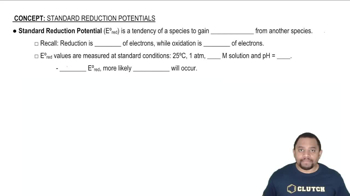
Standard Reduction Potential (E°red)

Standard reduction potential (E°red) is a measure of the tendency of a chemical species to gain electrons and be reduced. It is measured in volts and is determined under standard conditions (1 M concentration, 1 atm pressure, and 25°C). A higher E°red value indicates a greater likelihood of reduction occurring, which is crucial for predicting the direction of redox reactions.
Video consigliato:
Percorso guidato
01:10
Standard Reduction Potentials

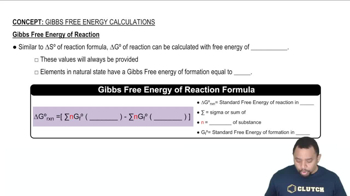
Gibbs Free Energy (∆G°)

Gibbs free energy (∆G°) is a thermodynamic quantity that indicates the spontaneity of a reaction at constant temperature and pressure. It is calculated using the equation ∆G° = -nFE°cell, where n is the number of moles of electrons transferred, F is Faraday's constant, and E°cell is the cell potential. A negative ∆G° value signifies that the reaction is spontaneous under standard conditions.
Video consigliato:
Percorso guidato
01:51
Gibbs Free Energy of Reactions

Half-Reaction Method

The half-reaction method involves breaking down redox reactions into their oxidation and reduction components. Each half-reaction can be analyzed separately to determine the E°red values and the overall cell potential. This method is essential for calculating the Gibbs free energy change for the entire reaction, as it allows for the identification of the number of electrons transferred and the respective potentials involved.
Video consigliato:
Percorso guidato
01:49
Method 1 of Radioactive Half-Life