
Ch.20 - Electrochemistry
Brown - Chemistry: The Central Science 15th Edition
Brown15th EditionChemistry: The Central ScienceISBN: 9780137542970Non è quello che usi tu?Cambia libro di testo
Capitolo 20, Problema 57

If the equilibrium constant for a two-electron redox reaction at 298 K is 1.5 * 10⁻⁴, calculate the corresponding ∆G° and E°.

Guida verificata passo dopo passo
1
Step 1: Recall the relationship between the equilibrium constant (K) and the standard Gibbs free energy change (∆G°) using the equation: ∆G° = -RT ln(K), where R is the universal gas constant (8.314 J/mol·K) and T is the temperature in Kelvin.
Step 2: Substitute the given values into the equation: R = 8.314 J/mol·K, T = 298 K, and K = 1.5 * 10⁻⁴. Calculate the natural logarithm of the equilibrium constant, ln(K).
Step 3: Calculate ∆G° by substituting the values of R, T, and ln(K) into the equation ∆G° = -RT ln(K).
Step 4: Use the relationship between ∆G° and the standard cell potential (E°) for a redox reaction: ∆G° = -nFE°, where n is the number of moles of electrons transferred (n = 2 for this reaction) and F is the Faraday constant (96485 C/mol).
Step 5: Rearrange the equation to solve for E°: E° = -∆G°/(nF). Substitute the calculated value of ∆G° and the known values of n and F to find E°.

Concetti chiave

Ecco i concetti essenziali che devi comprendere per rispondere correttamente alla domanda.

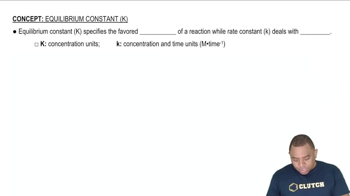
Equilibrium Constant (K)

The equilibrium constant (K) quantifies the ratio of the concentrations of products to reactants at equilibrium for a given reaction at a specific temperature. For redox reactions, K can indicate the extent to which reactants are converted to products, with larger values suggesting a greater tendency for the reaction to proceed forward.
Video consigliato:
Percorso guidato
01:14
Equilibrium Constant K

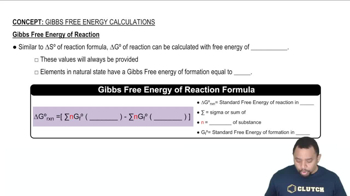
Gibbs Free Energy (∆G°)

Gibbs free energy (∆G°) is a thermodynamic potential that measures the maximum reversible work obtainable from a thermodynamic process at constant temperature and pressure. It is related to the equilibrium constant by the equation ∆G° = -RT ln(K), where R is the universal gas constant and T is the temperature in Kelvin.
Video consigliato:
Percorso guidato
01:51
Gibbs Free Energy of Reactions

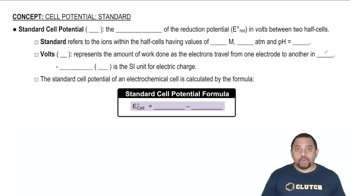
Standard Electrode Potential (E°)

The standard electrode potential (E°) is a measure of the tendency of a chemical species to be reduced, expressed in volts. It is related to the Gibbs free energy change by the equation ∆G° = -nFE°, where n is the number of moles of electrons transferred and F is Faraday's constant. A positive E° indicates a spontaneous reaction under standard conditions.
Video consigliato:
Percorso guidato
01:27
Standard Cell Potential