
Ch.20 - Electrochemistry
Brown - Chemistry: The Central Science 15th Edition
Brown15th EditionChemistry: The Central ScienceISBN: 9780137542970Non è quello che usi tu?Cambia libro di testo
Capitolo 20, Problema 82b

In some applications nickel–cadmium batteries have been replaced by nickel–zinc batteries. The overall cell reaction for this relatively new battery is: 2 H2O(l) + 2 NiO(OH)(s) + Zn(s) → 2 Ni(OH)2(s) + Zn(OH)2(s) (b) What is the anode half-reaction?

Guida verificata passo dopo passo
1
Identify the reactants and products in the overall cell reaction to determine the changes occurring at each electrode.
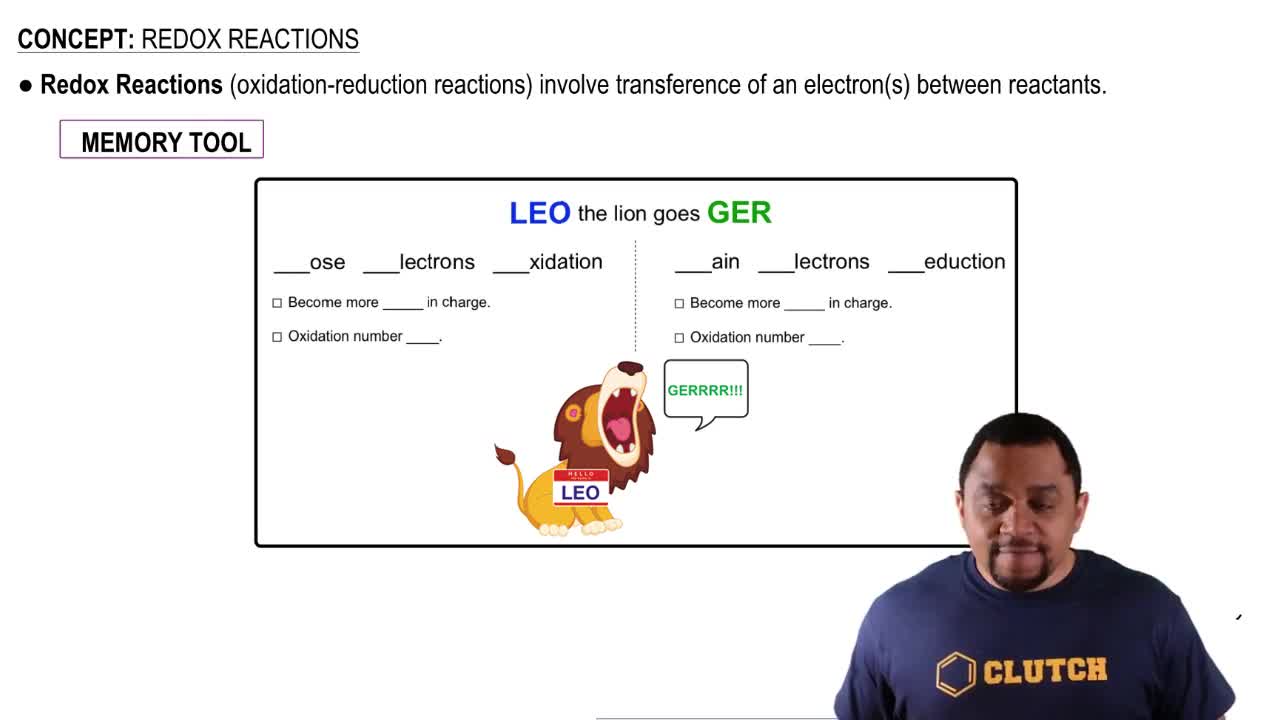
Recognize that the anode is where oxidation occurs in a battery. Oxidation involves the loss of electrons.
Examine the overall reaction to find which reactant loses electrons. In this case, zinc (Zn) starts as a solid and ends up in a compound, indicating it likely undergoes oxidation.
Write the oxidation half-reaction for zinc. Start with the elemental form of zinc and show its transformation into its oxidized form, incorporating the appropriate number of electrons to balance the reaction.
Balance the half-reaction for mass and charge, ensuring the number of atoms and the electrical charges are equal on both sides of the equation.

Risposta video verificata per un problema simile:

Questa soluzione video è stata consigliata dai nostri tutor come utile per risolvere questo problema.
Durata del video:
8m

Concetti chiave

Ecco i concetti essenziali che devi comprendere per rispondere correttamente alla domanda.

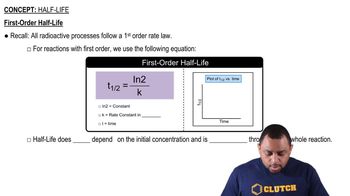
Half-Reactions

Half-reactions are the individual reactions that occur at the anode and cathode in an electrochemical cell. They represent the oxidation and reduction processes separately. In the context of batteries, the anode half-reaction involves the loss of electrons, while the cathode half-reaction involves the gain of electrons. Understanding half-reactions is crucial for analyzing the overall cell reaction.
Video consigliato:
Percorso guidato
01:49
First-Order Half-Life

Oxidation and Reduction

Oxidation is the process where a substance loses electrons, while reduction is the gain of electrons. In electrochemical cells, the anode is where oxidation occurs, and the cathode is where reduction takes place. Identifying which species is oxidized and which is reduced helps in determining the half-reactions and understanding the flow of electrons in the circuit.
Video consigliato:
Percorso guidato
01:53
Oxidation and Reduction Reactions

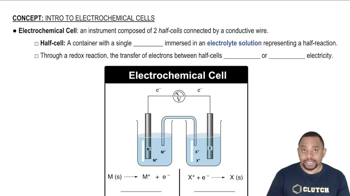
Electrochemical Cells

Electrochemical cells convert chemical energy into electrical energy through redox reactions. They consist of two electrodes (anode and cathode) and an electrolyte. The flow of electrons from the anode to the cathode generates electric current. Knowing the structure and function of electrochemical cells is essential for analyzing battery reactions and their applications.
Video consigliato:
Percorso guidato
02:46
Electrochemical Cells
Pratica correlata
Domanda del libro di testo

In some applications nickel–cadmium batteries have been replaced by nickel–zinc batteries. The overall cell reaction for this relatively new battery is: 2 H2O(l) + 2 NiO(OH)(s) + Zn(s) → 2 Ni(OH)2(s) + Zn(OH)2(s) (c) A single nickel–cadmium cell has a voltage of 1.30 V. Based on the difference in the standard reduction potentials of Cd2+ and Zn2+, what voltage would you estimate a nickel–zinc battery will produce? (d) Would you expect the specific energy density of a nickel–zinc battery to be higher or lower than that of a nickel–cadmium battery?

597
views
Domanda del libro di testo

During the discharge of an alkaline battery, 4.50 g of Zn is consumed at the anode of the battery. (b) How many coulombs of electrical charge are transferred from Zn to MnO2?

778
views
1
rank
Domanda del libro di testo

Li-ion batteries used in automobiles typically use a LiMn2O4 cathode in place of the LiCoO2 cathode found in most Li-ion batteries. (a) Calculate the mass percent lithium in each electrode material.

713
views
Domanda del libro di testo

Heart pacemakers are often powered by lithium–silver chromate 'button' batteries. The overall cell reaction is 2 Li(s) + Ag2CrO4(s) → Li2CrO4(s) + 2 Ag(s) (b) Choose the two half-reactions from Appendix E that most closely approximate the reactions that occur in the battery. What standard emf would be generated by a voltaic cell based on these half-reactions?

840
views
Domanda del libro di testo

Li-ion batteries used in automobiles typically use a LiMn2O4 cathode in place of the LiCoO2 cathode found in most Li-ion batteries. (b) Which material has a higher percentage of lithium? Does this help to explain why batteries made with LiMn2O4 cathodes deliver less power on discharging?

346
views
Domanda del libro di testo

Heart pacemakers are often powered by lithium–silver chromate 'button' batteries. The overall cell reaction is 2 Li(s) + Ag2CrO4(s) → Li2CrO4(s) + 2 Ag(s) (a) Lithium metal is the reactant at one of the electrodes of the battery. Is it the anode or the cathode?

438
views