Ch.20 - Electrochemistry
Brown - Chemistry: The Central Science 15th Edition
Brown15th EditionChemistry: The Central ScienceISBN: 9780137542970Non è quello che usi tu?Cambia libro di testo
Capitolo 20, Problema 43

The standard reduction potentials of the following halfreactions are given in Appendix E:
Ag+(aq) + e- → Ag(s)
Cu2+(aq) + 2 e- → Cu(s)
Ni2+(aq) + 2 e- → Ni(s)
Cr3+(aq) + 3 e- → Cr(s)
(a) Determine which combination of these half-cell reactions leads to the cell reaction with the largest positive cell potential and calculate the value.
(b) Determine which combination of these half-cell reactions leads to the cell reaction with the smallest positive cell potential and calculate the value.

Guida verificata passo dopo passo
1
Identify the standard reduction potentials for each half-reaction from Appendix E.
Write the half-reactions with their respective standard reduction potentials: \( \text{Ag}^+ + e^- \rightarrow \text{Ag} \), \( \text{Cu}^{2+} + 2e^- \rightarrow \text{Cu} \), \( \text{Ni}^{2+} + 2e^- \rightarrow \text{Ni} \), \( \text{Cr}^{3+} + 3e^- \rightarrow \text{Cr} \).
To find the smallest positive cell potential, consider pairing the half-reactions such that one acts as an oxidation reaction (reverse the reaction and change the sign of the potential).
Calculate the cell potential for each possible combination by adding the reduction potential of the cathode and the oxidation potential of the anode.
Select the combination with the smallest positive cell potential and ensure the overall reaction is balanced in terms of electrons.

Risposta video verificata per un problema simile:

Questa soluzione video è stata consigliata dai nostri tutor come utile per risolvere questo problema.
Durata del video:
3m

Concetti chiave

Ecco i concetti essenziali che devi comprendere per rispondere correttamente alla domanda.

Standard Reduction Potentials

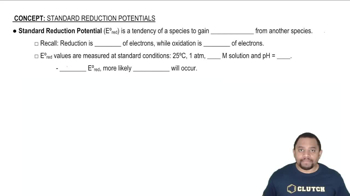
Standard reduction potentials (E°) indicate the tendency of a species to gain electrons and be reduced. Each half-reaction has a specific E° value, which is measured under standard conditions. A higher E° value means a greater likelihood of reduction. When combining half-reactions, the overall cell potential is determined by the difference between the reduction potential of the cathode and the anode.
Video consigliato:
Percorso guidato
01:10
Standard Reduction Potentials

Cell Potential Calculation

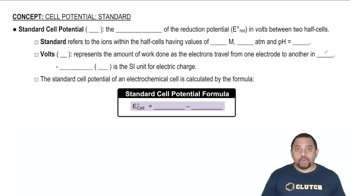
The cell potential (E_cell) for an electrochemical cell is calculated using the formula E_cell = E_cathode - E_anode. This equation helps determine the driving force of the electrochemical reaction. A positive E_cell indicates a spontaneous reaction, while a negative value suggests non-spontaneity. To find the smallest positive cell potential, one must evaluate various combinations of half-reactions.
Video consigliato:
Percorso guidato
01:27
Standard Cell Potential

Half-Cell Reactions

Half-cell reactions represent the reduction or oxidation processes occurring in an electrochemical cell. Each half-cell consists of a metal ion and its corresponding solid metal, along with electrons. Understanding how to combine these half-reactions is crucial for predicting the overall cell reaction and its potential. The choice of half-cells directly influences the cell potential and the feasibility of the reaction.
Video consigliato:
Percorso guidato
01:49
First-Order Half-Life